Packaging
Packaging system/Containers
Definition:
Packaging is any means used to protect, bundle, store, transport and label a product.
In logistics and industry — particularly in the chemical, food and pharmaceutical industries — packaging fulfils regulatory and safety-related functions in addition to physical protection.
They are a central part of the supply chain and make a significant contribution to product quality, process reliability and sustainability.
Types of packaging and container systems:
- Primary packaging
Direct contact with the product (e.g. canister, bottle, bag, drum).
Serves to protect and keep the goods clean. - Secondary packaging
Wrapping or combining several primary packagings into one logistical unit (e.g. carton, box, shrink film). - Tertiary packaging
Enables storage and transportation (e.g. pallets, IBCs, big bags, mesh boxes). - Reusable and pooling packaging
Systems designed for reuse and recycling (e.g. CHEP boxes, reusable drums, plastic pallets).
Special packaging forms in industry
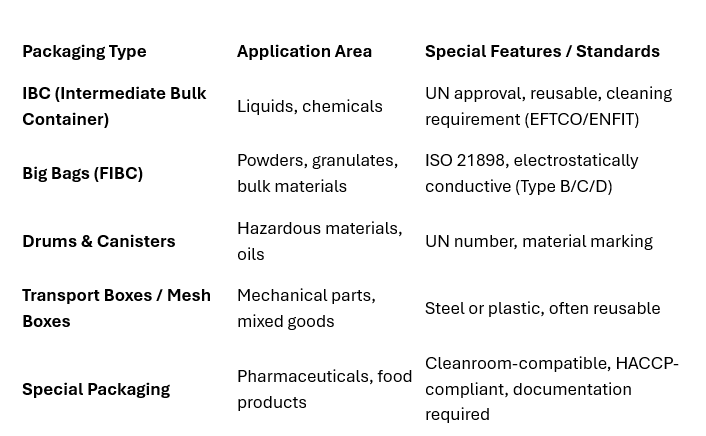
Relevant norms & standards
- ISO 9001/ISO 14001 — Quality & environmental management
- ISO 16106/ISO 21898 — Packaging for dangerous goods & FIBC
- UN Recommendations on the Transport of Dangerous Goods
- ISPM-15 — Wood packaging in international trade
- EFTCO/ENFIT guidelines — Cleaning & hygiene standards
- Packaging G (DE) — Act on the Marketing and Recycling of Packaging
Sources/further links:
ISO 21898:2004 — Flexible Intermediate Bulk Containers (FIBC): ISO 21898:2024 - Packaging — Flexible intermediate bulk containers (FIBCs) for non-dangerous goods
Federal Environment Agency — Packaging Act (VerpackG): https://www.umweltbundesamt.de
Packaging handling challenges:
- Lack of standardization & lack of transparency in the supply chain
Packaging requirements (e.g. approved containers, cleaning conditions, UN certification) are often communicated manually or incompletely.
→ Consequence: incorrect shipments, product contamination or downtime.
Sources/further links:
ECTA/CEFIC — Best Practices on Cleaning and Packaging: Guidelines | ECTA - European Chemical Transport Association
- Return processes and cleaning obligations
In the case of reusable packaging (e.g. IBCs, drums), cleaning processes, return logistics and documentation requirements are complex and often uncoordinated.
Sources/Further links:
EFTCO — eECD System & Cleaning Requirements: https://www.eftco.org
- Sustainability & regulatory pressure
The Packaging Act (VerpackG) and EU regulations require recyclability and proof of reuse.
Many companies do not have any central data to efficiently prove these requirements.
Sources/further links:
European Commission — Packaging and Packaging Waste Regulation: https://environment.ec.europa.eu
Loady's solution:
Central definition of packaging and packaging requirements
Loady makes it possible to clearly define for each assigned product to a loading or unloading point which types of packaging (e.g. IBC, big bag, canister, pallet) are approved, recommended or excluded.
In this way, packaging requirements are consistently communicated across the entire supply chain.
Clear identification of cleaning and return requirements
For reusable and dangerous goods packaging, cleaning requirements, EECD obligations and return conditions can be stored in a standardized manner in Loady.
This creates transparency and facilitates compliance with UN, ISO and EFTCO requirements.
Multilingual and uniform database
All partners — from shippers to carriers to drivers — access the same, multilingual database.
This prevents packaging requirements from being misinterpreted or overlooked.