ADR
Definition:
The ADR (Accord européen relatif au transport international des marchandises dangereuses par route) is an international agreement that regulates the transport of dangerous goods by road. The ADR contains detailed regulations for packaging, labelling and load securing of dangerous goods in order to ensure safety during transport. Originally a European agreement, ADR is now used worldwide. It was signed in Geneva in 1957 and has been in force since 1968. The ADR classifies dangerous goods into different classes, depending on the type of hazard (e.g. explosive substances, flammable liquids). The ADR also determines which documents must be carried during transport, including dangerous goods transport documents. Drivers and other persons involved in transportation must complete special training courses and refresh them regularly.
ADR dangerous goods classes:
The ADR divides hazardous substances into nine dangerous goods classes, which are categorized according to the type of hazard. This classification ensures that transport, labelling and safety measures are regulated uniformly and comprehensibly. Classes include:
- Class 1: Explosives and objects (e.g. dynamite, explosives)
- Class 2: Gases
- Class 2.1: Flammable gases (e.g. propane, butane)
- Class 2.2: Non-flammable, non-toxic gases (e.g. nitrogen, carbon dioxide)
- Class 2.3: Toxic gases (e.g. chlorine, ammonia)
- Grade 3: Flammable liquids (e.g. gasoline, ethanol, acetone)
- Class 4.1: Flammable solid substances (e.g. sulfur, matches)
- Class 4.2: Spontaneously flammable substances (e.g. white phosphorus)
- Class 4.3: Substances that form flammable gases when in contact with water (e.g. sodium, potassium)
- Class 5.1: Inflammatory (oxidizing) substances (e.g. ammonium nitrate)
- Class 5.2: organic peroxides (e.g. benzoyl peroxide)
- Class 6.1: Toxic substances (e.g. arsenic, hydrocyanic acid)
- Class 6.2: Contagious substances (e.g. medical waste)
- Class 7: radioactive substances (e.g. uranium, plutonium)
- Class 8: Corrosive substances (e.g. sulfuric acid, caustic soda)
- Class 9: Various hazardous substances and objects (e.g. lithium batteries, dry ice)
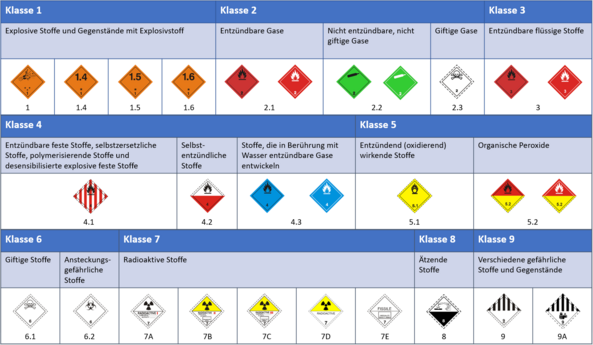
Source/further links: Labelling and Labelling - BG RCI
Vehicle equipment and documentation regulations mention:
The ADR prescribes what safety and emergency equipment vehicles must carry, including fire extinguishers, personal protective equipment, safety vests, and emergency cards. In addition, the ADR defines mandatory documentation such as transport documents, written instructions and training certificates. These guidelines are used to be able to react quickly and appropriately in an emergency.
ADR challenges in transportation:
Complex and safety-critical requirements for transporting dangerous goods
The transportation of dangerous goods is subject to strict safety and compliance rules. Companies must ensure that substances are correctly classified, labelled, documented and handled. Even minor errors in data or processes can lead to serious risks to health, the environment and infrastructure.
Source/further links:
UNECE ADR Framework, European Commission Transport of Dangerous Goods Guidance: Dangerous Goods | UNECE
Decentralized, inconsistent and often manual information processes
In many companies, information on hazardous goods and loading requirements is maintained in various systems or documents (e.g. Excel lists, PDF documents, emails). This results in media breaks, version conflicts and coordination efforts between logistics, dangerous goods officers and transport partners. Incorrect or missing information leads to delays or incorrect transport preparations.
Source/further links:
High legal and financial risks in the event of errors or violations
Violations of ADR regulations can have significant consequences — from security incidents and transport interruptions to fines, liability risks and criminal consequences. Companies therefore have a high responsibility to provide correct and up-to-date information and to be able to prove it at any time.
Source/Continuing links:
UNECE ADR compliance requirements: ADR 2025 - Agreement concerning the International Carriage of Dangerous Goods by Road | UNECE
EU catalog of dangerous goods fines: Transport of dangerous goods - Truck Fines Catalogue 2026
Loady's solution:
Centralized, structured dangerous goods and location information
Loady ensures that all safety-relevant requirements — from location and loading conditions to product-specific requirements — are maintained in a central, validated data source. Information is consistent, complete and available to all eligible partners.
Multilingual, standardized data for smooth processes
With Loady, drivers and logistics partners receive clear and uniform requirements, even before they arrive at the location — including ADR-relevant information. This reduces misunderstandings, waiting times and inquiries and increases planning security and compliance.
Comprehensible and consistent data storage
The central data platform makes it possible to see at any time which requirements apply, who maintained them and when they were updated. This creates transparency and supports proof of compliance with authorities and partners.