
FAQs for Loady users
We are happy to support you with the initial setup of the data. Based on our experience, we can recommend some best practices. Generally, during the initial data setup on Loady, it is advisable to designate a central contact person to coordinate and monitor the setup (e.g., ensuring all sites are created, all products assigned).
Additionally, expertise from various departments is required for data setup. Which departments actually need to be involved in the data setup depends on the client's organization and the distribution of responsibilities. Based on previous experience, expertise from the following departments is needed:
- Sites and loading/unloading points within your own company: employees from site management or those responsible for loading/unloading points
- Company products: Employees from product management, quality management, or technical marketing
- Business Partners and all associated objects such as sites, unloading points, inbound products and associated unloading requirements are usually maintained or managed by customer service or sales employees
- Previous loading restrictions: Employees from quality management, technical marketing, or those responsible for loading points
- Tenders: Employees from the purchasing organization
- ERP structure: Key users or employees from IT departments
A fundamental prerequisite for deleting objects in Loady is that the object is not contained in any connecting elements, such as in requirement profiles and lanes .
Examples:
- To delete an outbound product, all requirement profiles and lanes in which the outbound product is contained must first be deleted.
- At all loading/unloading points where the company product was assigned as an inbound or outbound product , it must be removed before it can be deleted.
To delete various objects in Loady, the following order must be observed:
- Requirement profiles
- Lanes
- Inbound and outbound products
- Company products
- Loading and unloading points (buildings)
- Sites
- Business partners
Requirement Profiles are designed so that the objects contained therein (Business Partner, Site, Unloading Point, Inbound Product) cannot be exchanged or replaced by others after creation. This is because a requirement profile establishes a unique combination of these objects.
Therefore, if a Business Partner, an Inbound Product or an Unloading Point needs to be adjusted within a requirement profile, a new requirement profile with the desired objects must be created. If the requirement profile with the original objects is no longer needed, it must be deleted.
It is not currently possible to directly restore data within Loady. Please contact the Customer Success Team.
Loady currently does not support PDF uploads. You can upload the PDF to a website and insert a link as a URL in the corresponding free text field in Loady.
Currently, Loady offers copy functions for various data and objects. The existing copy functions are presented below:
Copy functions for Company Products:
- Copying the entire company product
- Navigate to the product list via the navigation bar
- Click the copy icon in the top right corner
- In the pop-up, select the appropriate company and the company product to be copied
- The copied company product appears with the suffix (copy) in the product list for further editing

Copying the module Cleaning Requirements
- Navigate to the Cleaning Requirements of the company product into which the existing Cleaning Requirements of another company product are to be copied
- Click the copy icon in the top right corner
- In the pop-up, select the appropriate company and the company product from which the Cleaning Requirements are to be copied
- The Cleaning Requirements will be copied and will overwrite existing data
Copying Previous loading restrictions
- Navigate to the Previous loading restrictions of the company product into which the existing Previous loading restrictions of another company product are to be copied
- Click the copy icon in the top right corner
- In the pop-up, select the appropriate company and the company product from which the Previous loading restrictions are to be copied
- The Previous loading restrictions will be copied and will overwrite existing data
Copy functions for Inbound and Outbound Products
- Navigate to a module of an Inbound or Outbound Product, into which data is to be copied
- Click the copy icon in the top right
- In the pop-up, select the appropriate company, the appropriate Site, the appropriate Loading Point, the desired modules, and the appropriate Inbound or Outbound Product from which requirements are to be copied
- The desired requirements will be copied into the selected modules, overwriting existing data. Important: Only data from selected modules will be copied and overwritten. If modules are not selected, the existing data will remain unchanged
An Inbound or Outbound Master includes requirements that apply to multiple Inbound or Outbound Products at a loading/unloading point. For example: At a site there is a loading point where 10 Outbound Products are loaded with identical loading requirements. Instead of maintaining the requirements 10 times for the individual products, these requirements can be stored once in an Outbound Master . When the Outbound Products are assigned to this Outbound Master , the requirements maintained at the master level are transferred to the individual Outbound Products.
The creation and maintenance of an Outbound Master (Inbound Master similarly) is done as follows:
- Create the Outbound Master as an object and maintain the requirements
- Assign the associated Outbound Products to the Outbound Master
Important: As soon as Outbound Products are assigned to an Outbound Master , the originally stored data of the individual Outbound Productswill be overwritten. This means they are deleted and cannot be restored. If Outbound Products are removed from an Outbound Master , the master's requirements remain, but the data is simply no longer synchronized. From this point on, they must be manually edited at the product level.
In cases where free text fields are not maintained in all input languages available on Loady, Loady defaults to the standard language English . This means that free text fields must always be maintained in at least English. Otherwise, data in free text fields cannot be saved. If Loady is used in another language, e.g., German, to maintain the content in English, the input language must be changed via the language selection for free text fields to English.

If the data is only maintained in English, the English entry will be displayed as a fallback when Loady is used in another language.
Currently, only data related to created lanes can be downloaded. This includes data for actively used lanes under Lane Management or data for lanes assigned to a tender (Loady4Tender), can be downloaded.
For additional data exports, the Customer Success Team can be requested.
In many submodules, free text fields are available that can be used. If the data could benefit from a structured field (e.g., recurring data), please contact the Customer Success Team. We will work with you to find a solution.
Missing dropdown values can be requested in the same way. If it's a value commonly used as a standard in the (chemical) logistics environment, it can be added quickly.
For all objects that can be created in Loady, there is the option to perform the (initial) setup via CSV upload:
- Company Products
- Sites
- Loading/Unloading Points (own company/business partner)
- Assignment of products to loading/unloading points (own company/business partner)
- Business Partners
- Requirement Profiles
- Lanes & Update Partners in Lanes
- Previous loading Restrictions
Please note that via CSV upload no requirements can be uploaded. For some objects, basic information can also be created in the CSV templates (e.g., unloading times, addresses). Generally, objects can be created via CSV upload, but the requirements must then be maintained via the user interface.
Initially, the object structure should be set up in Loady (sites, loading points, assignment of products to loading points, company products, business partners including sites, unloading points, assignment of products to unloading points). It is important to consider the dependencies between the individual object types (e.g., a loading point cannot be created before the site has been set up; a company product cannot be assigned to an unloading point at a business partner before the business partner, the business partner's site, and the unloading point exist).

Once the object structure has been set up, you can begin managing the requirements at the level of the respective objects.
If an integration is performed via the Loady API, the reference numbers of the Ship-to-Parties from the ERP/TMS system must be used for creating Business Partners on Loady.
There is no universal solution for structuring data in Loady. The structure in Loady should mirror the data structure of the ERP system. The following provides some guidance to minimize potential conflicts.
Object names should be clear and unambiguous to ensure good clarity. For a functional exchange of data between the ERP system and Loady, the field ERP Reference Number, which must be maintained for each object, is crucial. The exact designation from the ERP system must be entered here.
For optimal clarity and assignment of different loading/unloading requirements, it is recommended that separate loading/unloading points be created for clearly distinguishable loading procedures.
The following are examples of how loading/unloading points can be divided according to different loading procedures:
- Bulk products vs. packed products
- Container vs. truck loading
For example, a site could be created in Loady that includes several loading/unloading points.
In this example, these are clearly separated by the type of goods being loaded or the processes required for loading:
- Site: 001
- Loading Point: 001_Bulk
- Loading Point: 001_Packed_ Truck Loading
- Loading Point: 001_Packed_ Container Loading
Should any ambiguities arise regarding the data structure, our Customer Success Team is happy to provide individual consultation.
Transferring data between Loady and other systems requires integration via one of our APIs (Application Programming Interfaces). Loady offers various standardized APIs for different applications. Our customers' IT departments configure these integrations according to their specific needs. This means that data transfer must be individually defined within the customer's business processes.
Please contact the responsible integration manager or IT department directly. They can explain exactly how data transfer between Loady and other systems is initiated and executed.
Loady offers various tutorials. You can access the latest tutorials directly in Loady via the dashboard or through the following link: Tutorials

In addition, other tutorials are available to you, which are stored centrally within your organization (e.g., cloud storage). For these, please contact your internal Loady representative. We are continuously adding new tutorials and are planning a central location within the application for easy access. We prioritize the creation of tutorials based on our assessment of customer needs.
Should you urgently need a tutorial on a specific topic, please contact support@loady.com. This allows us to take it into account in our internal prioritization.
If you have general questions about Loady, please contact support@loady.com. If your questions specifically relate to Previous Loading Restrictions or ePLR-Check, please contact plr-support@Loady.com
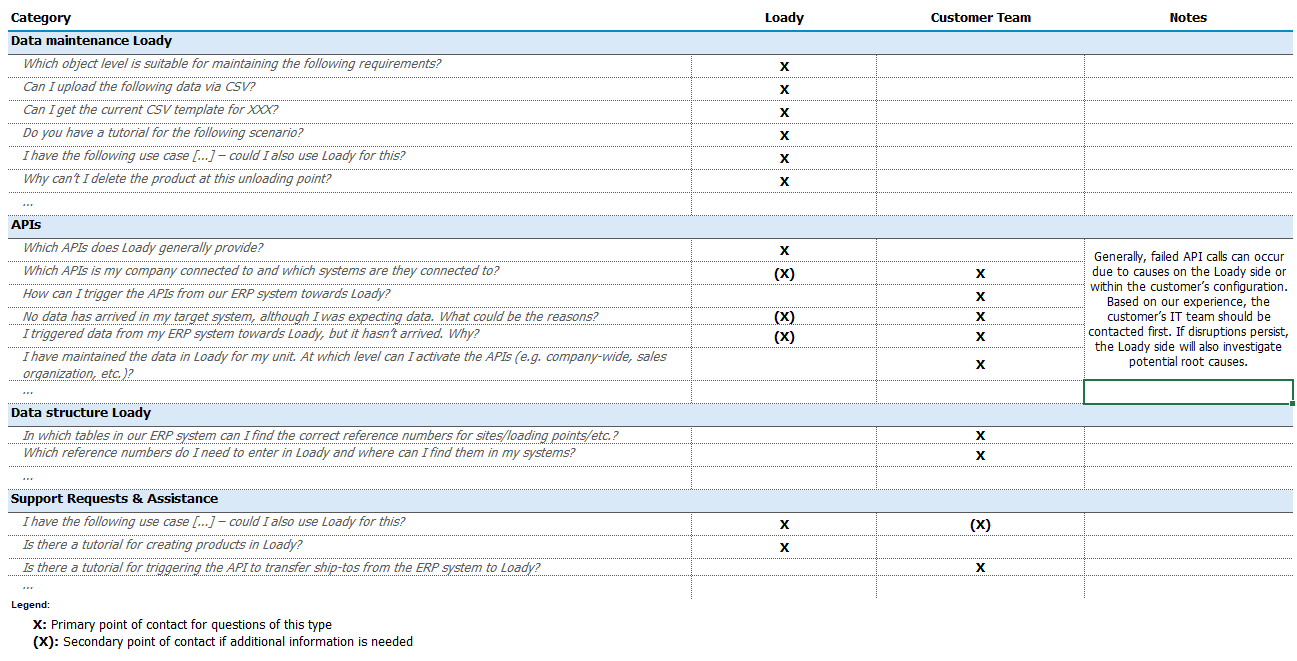
All questions that are related to Loady but concern processes or systems within the customer's company must be directed to the respective responsible parties within the company (e.g., IT department, application owner, administrators, support mailboxes).
The attached table shows which topic categories Loady or your own team can support.
Simply send us your idea by email to support@loady.com. We collect all ideas and evaluate them based on feasibility, effort, and suitability for Loady. You will receive an update on the status of your idea. If it involves a new, complex functionality, we will also contact you to clarify the specific requirements.
You might also like

