Structured pre-load restriction data as a cornerstone for digital collaboration in liquid bulk logistics
A position statement by Loady on the further development of quality and cleaning processes.
Executive Summary
The safe and efficient logistics of liquid products depends largely on the control of so-called pre-loading restrictions — i.e. the rule of which substances may be transported in a tank or container before a specific product.
So far, these checks have been based on manually maintained lists and individual experience.
This results in high costs, inconsistent data and avoidable incidents at factory gates and cleaning systems.
By providing a solution for structured pre-load restriction data, Loady has for the first time created a common, digitally enabled database that standardizes, verifiable and interoperable this safety-relevant information.
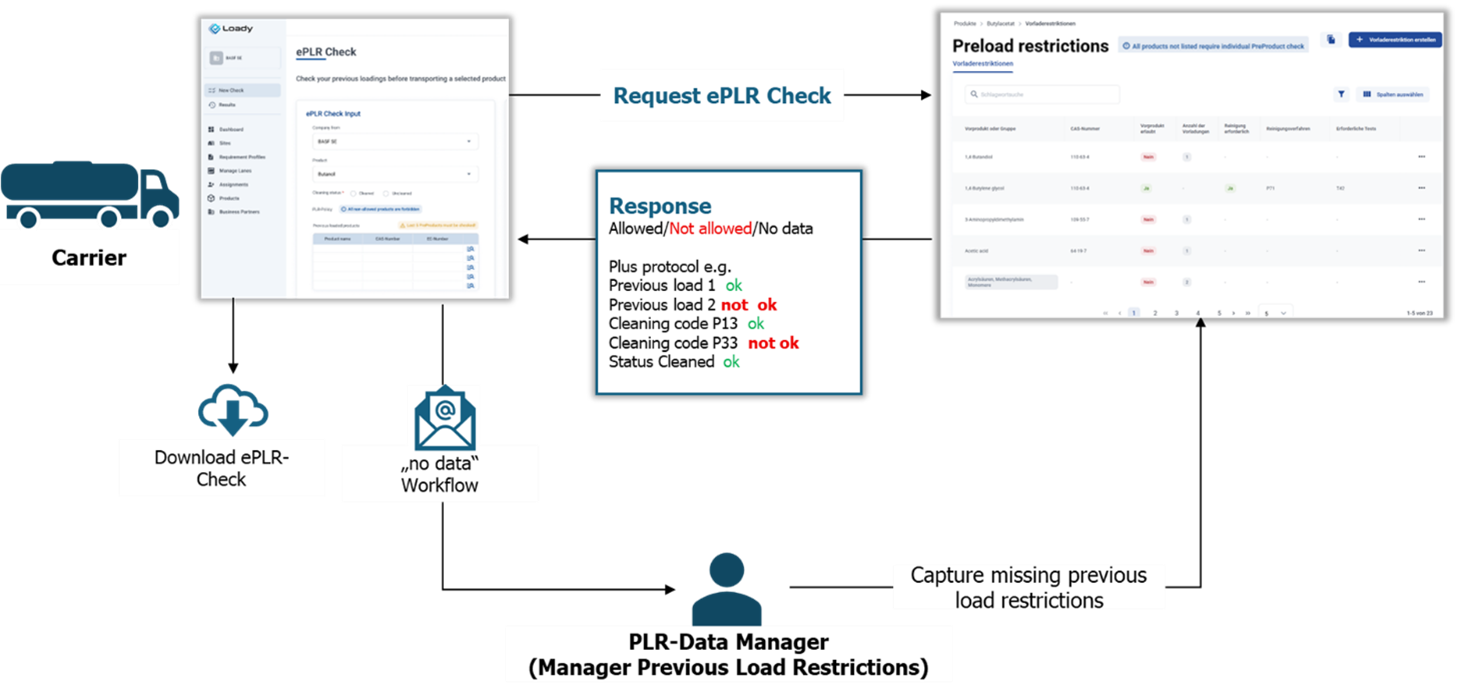
It enables both manual pre-product testing — via a uniform user interface — and automated controls via API interfaces, which can be integrated into transport or yard management systems at shippers or freight forwarders.
This data basis forms the basis for a new form of digital collaboration in the logistics of liquid products: It reduces manual verification efforts, improves planning and cleaning decisions and opens up prospects for further applications — such as linking with cleaning station applications, which create cleaning certificates and provide them in paper form — or with providers of electronic cleaning certificates (eECD) such as ECLIC or Bulkvision. In both cases, validated proof of the test result would be directly on the printed, PDF or electronic cleaning certificate.
Loady is thus positioning itself as an enabler for data-driven quality assurance in chemical and food processing logistics — today as an independent solution, tomorrow as a central component of a networked digital ecosystem.
[...]
Manual or automated pre-product testing (ePLR check)
- Freight forwarders check whether tank/ equipment and product combinations are permitted before dispatching
- Shippers carry out incoming checks before loading
The use of a uniform data source replaces individual list checks and creates a transparent, auditable basis for decision-making.
a. Structure and logic of the data model
Loady structures preload restrictions within a multi-layered, chemically and logistically coherent data model.
Key principles include:
· Unique identification by trade names, chemical names, CAS/ EC numbers, synonyms, and multi-lingual variants.
· Multi-level classification enabling rules at substance or group level (e.g. "all acids excluded", "amines allowed after defined cleaning").
· Clear rule typing: allowed, not allowed or allowed after special cleaning, including associated cleaning codes.
· Chemical logic layers to detect equivalences or relationships, even across different naming conventions.
· Number of preloads. i.e., how many previous loads need to be checked and in how many previous loads the respective product is forbidden.
· Quality assurance through validation, release workflows, and duplicate detection.