
Key takeaways
- Planned is not the same as ready: a transport can be perfectly planned in a TMS and still fail at the gate.
- Execution knowledge lives outside the systems: check-in procedures, access rules, safety requirements and loading procedures often sit in PDFs, emails and people's heads.
- AI makes the gap bigger: an AI dispatcher cannot follow a site procedure it does not know exists.
- Logistics Execution Readiness: a transport is ready when site, product, lane and partner requirements are known, current, structured and available.
- The foundation for automation: structured, maintained logistics requirements that connected systems can use via API.
AI-ready logistics starts where the TMS stops. Why structured pickup and delivery requirements are the missing foundation for intelligent transport planning and automation.
The freight order is complete. The carrier is assigned. The delivery slot is booked. Everything looks good in the Transport Management System (TMS).
Until the driver arrives at the site.
The driver didn't know that online check-in was mandatory before arrival. Or that the truck must first proceed to a designated parking area and wait for instructions. Or that arriving more than 20 minutes before the booked time slot is not permitted. And at some locations, the driver is even expected to load the truck himself.
None of these requirements is particularly unusual. They are part of everyday logistics operations. Yet they are often missing from the systems responsible for planning and executing transport.
This exposes a fundamental challenge: a transport can be perfectly planned in a TMS and still not be ready for execution.
The missing link between transport planning and logistics execution
Transport management systems have become increasingly sophisticated. They optimise routes, consolidate shipments, assign carriers, manage freight costs and coordinate delivery schedules.
But successful transport execution depends on much more than the information typically contained in a freight order. Every pickup and delivery location has its own operational requirements. These may include:
- Arrival and check-in procedures: mandatory online registration, security checkpoints, gate assignments or specific arrival sequences.
- Time slot and access restrictions: earliest permitted arrival times, booking requirements, site opening hours and restrictions outside regular operating hours.
- Loading and unloading procedures: driver self-loading, mandatory assistance, specific equipment or vehicle configurations.
- Safety and security requirements: personal protective equipment (PPE), site-specific safety instructions, mandatory driver briefings or access permits.
- Product-specific handling requirements: temperature restrictions, cleaning requirements, equipment compatibility or previous load restrictions.
And these requirements are not necessarily the same for every shipment to a particular site. They may differ between loading points, products, transport modes or even individual business partners.
Knowing the delivery address is not the same as knowing how a delivery can actually be executed.
Why this becomes a bigger problem with AI
Experienced transport planners and dispatchers have developed ways to compensate for missing information. They know which locations require special procedures. They remember previous incidents. They call the warehouse, contact the customer or ask a colleague who has handled the shipment before.
Much of this operational knowledge exists outside the systems. It lives in emails, spreadsheets, PDF instructions, local databases and people's experience.
That approach is already inefficient in traditional transport planning. But with AI-driven automation, it becomes a fundamental limitation:
- An AI dispatcher cannot reliably follow a site procedure it does not know exists.
- An autonomous transport planning agent cannot account for a mandatory check-in process if that requirement is not available in a structured, machine-readable format.
- An automated freight execution workflow cannot validate whether a truck is suitable for a loading point if the relevant restrictions are hidden in an outdated PDF.
AI can process enormous amounts of information. But access to information alone does not guarantee that the information is correct, complete, current or applicable to a specific transport.
The challenge is not simply making logistics data accessible to AI. It is making the right operational requirements available, reliable and usable for automated decisions.
From data availability to Logistics Execution Readiness
This is where the concept of Logistics Execution Readiness (LER) becomes important.
Logistics Execution Readiness means that all relevant requirements for executing a transport are known, current, structured and available before the transport takes place. It goes beyond checking whether a freight order contains the mandatory fields.
A transport is truly ready for execution when the systems and parties involved know not only what needs to be transported, where and when, but also under which conditions. Four dimensions are particularly relevant.
1. Site readiness
Are the operational requirements of the pickup and delivery locations available? This includes site access, opening hours, check-in procedures, safety instructions, parking arrangements and loading or unloading processes.
2. Product readiness
Are the product-specific transport and handling requirements known? In chemical logistics, for example, these may include temperature limits, material compatibility, previous load restrictions and cleaning requirements.
3. Lane readiness
Are all requirements relevant to the specific transport lane available for planning and execution? A lane connects more than just two geographical locations. It also connects the operational conditions that must be fulfilled at both ends of the transport.
4. Partner readiness
Do the relevant logistics partners have access to the information they need? Carriers, dispatchers, drivers, shippers and receiving sites must work with consistent, up-to-date requirements rather than disconnected copies of instructions.
Together, these dimensions establish a foundation for more reliable logistics execution and scalable automation.
Why unstructured logistics data limits automation
Many companies already have the information needed to execute their transports. The problem is how that information is maintained and shared.
A site instruction might exist as a 20-page PDF. Another location communicates its requirements by email. Product-specific restrictions are maintained in spreadsheets, while loading point details are stored in local systems. This creates three challenges for automation:
- Information is difficult to interpret consistently. A sentence such as “Drivers must report to the security office before entering the loading area” contains an operational rule. For an automated system, that rule needs to be represented in a way that can be identified, interpreted and applied.
- Information changes. Site procedures, opening hours and equipment requirements are not static. An AI system using an outdated instruction may generate a technically plausible but operationally incorrect plan.
- Context matters. A requirement may apply only to a particular loading point, product, carrier or transport type. Without that context, even correctly extracted information can lead to the wrong decision.
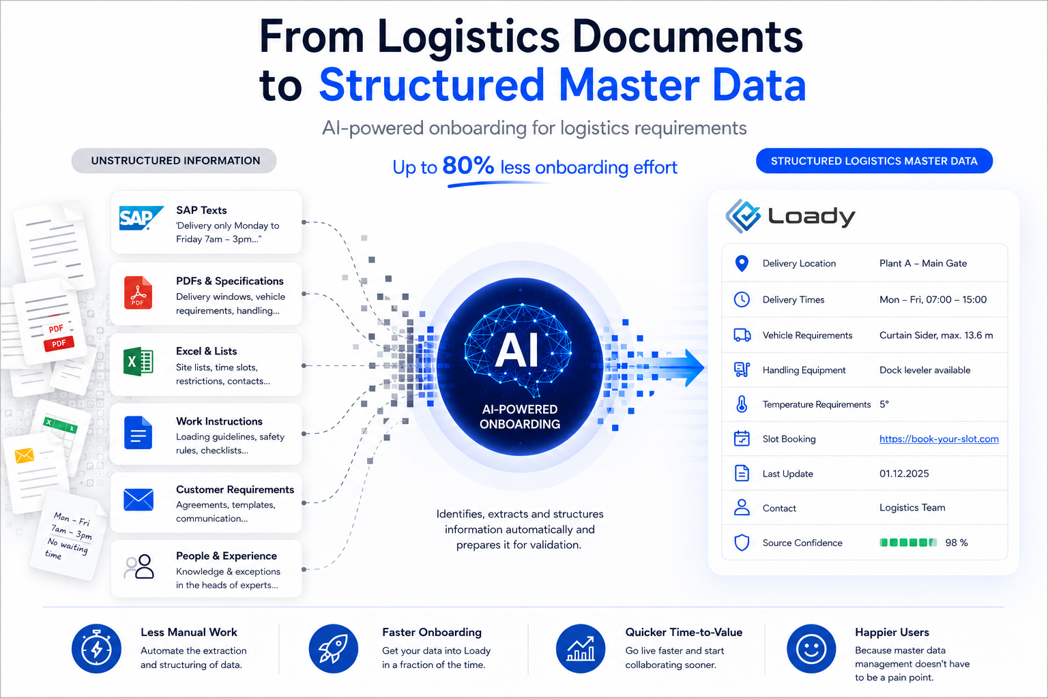
Simply converting PDFs into searchable documents is therefore not enough. AI can help a great deal with extracting and structuring requirements from free text. But in our experience with AI-supported data onboarding, around 10–20% of free texts still need human validation, because the information is incomplete, contradictory or outdated.
For reliable automation, logistics requirements need to be structured, contextualised, maintained and made available to the systems that use them.
How Loady helps build the foundation for AI-ready logistics
At Loady, we focus on a part of logistics digitalisation that is often overlooked: the operational requirements that determine whether a transport can actually be executed.
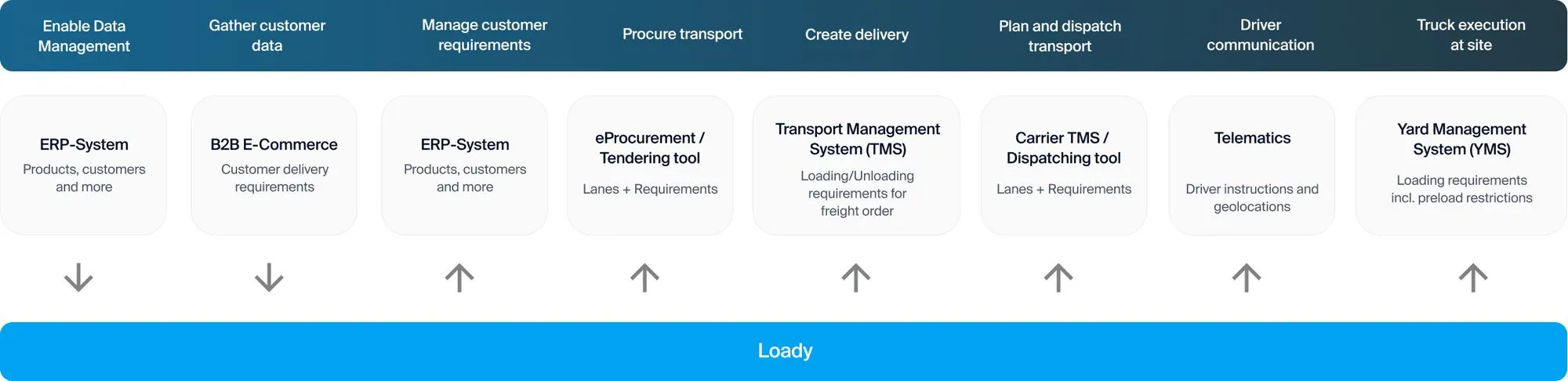
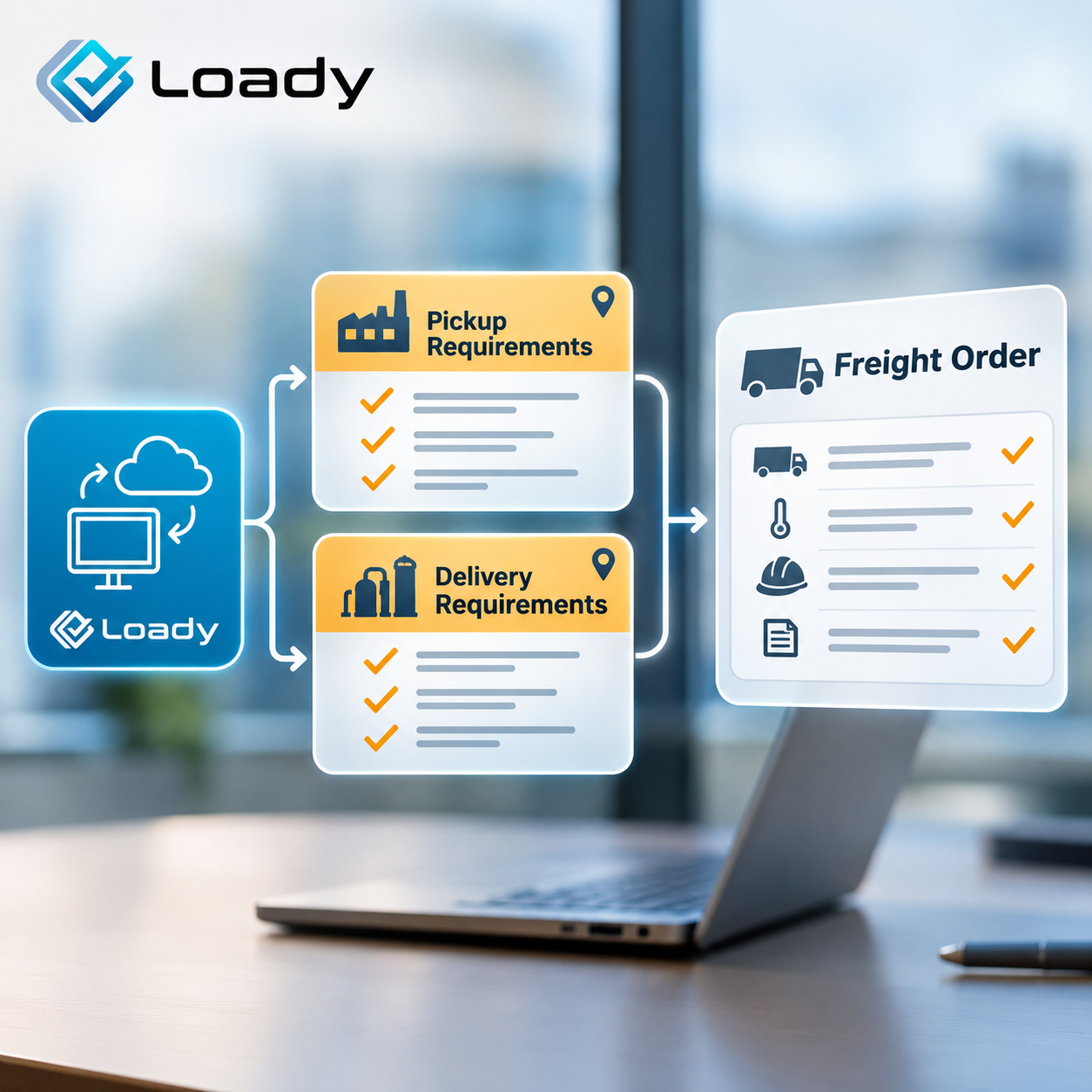
Loady provides a standardised platform for managing and sharing logistics requirements across companies and logistics partners. Instead of maintaining critical information in disconnected documents and communication channels, companies structure their requirements for sites, loading and unloading points, products and transport lanes.
This creates a common source of reliable logistics information that can be used across operational processes and integrated into existing IT environments, including ERP, TMS and other logistics applications. For example:
- Site-specific arrival and safety requirements can be maintained and shared with logistics partners.
- Loading and unloading requirements can be assigned to the relevant locations and loading points.
- Product-specific transport restrictions can be made available for planning and execution.
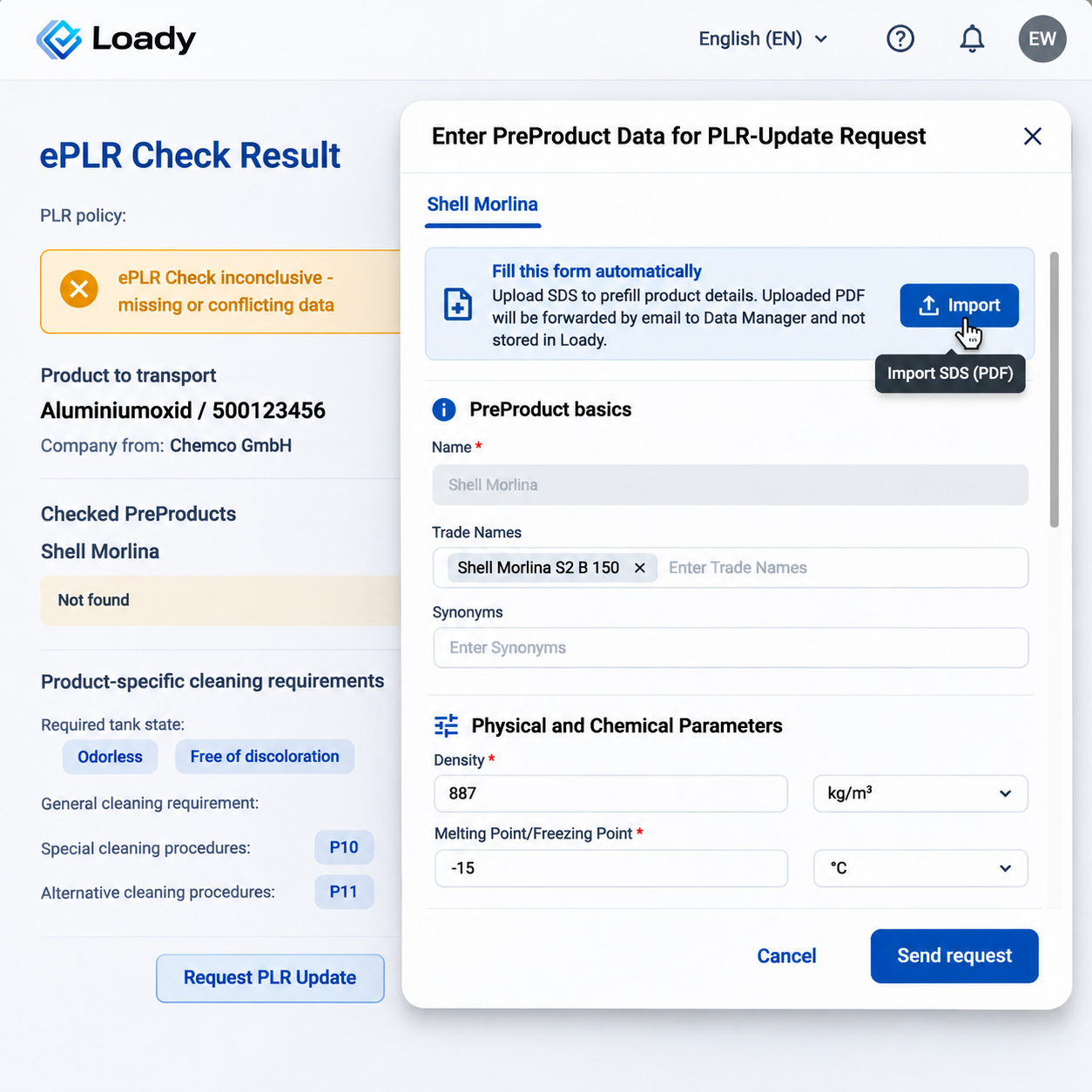
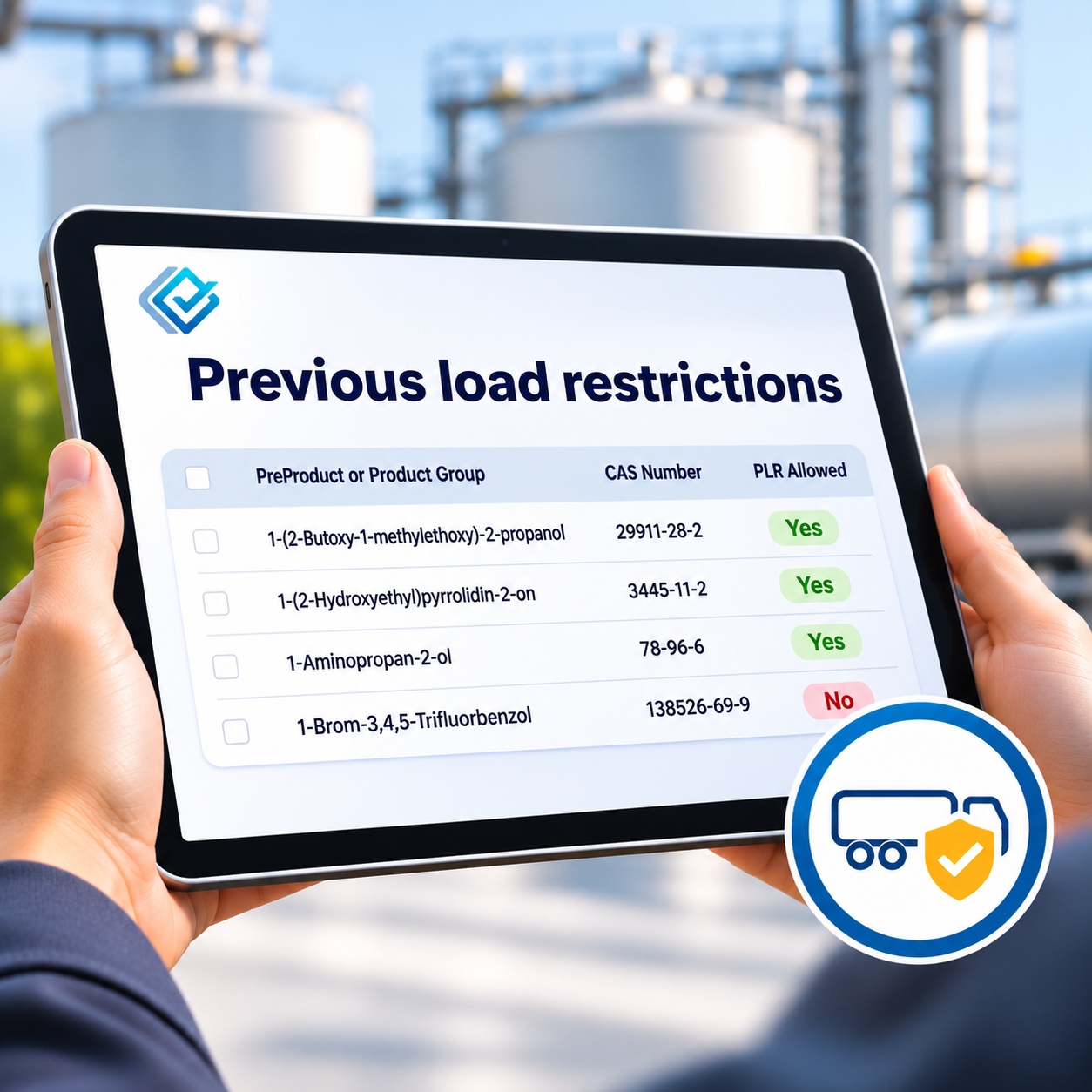
- Previous load restrictions and cleaning requirements can be verified digitally with the Loady ePLR Check.
- Structured logistics requirements can be made available to connected systems through APIs.
The objective is not to replace transport planning systems or AI-based dispatchers. It is to provide the reliable operational information they need to make better decisions.
Because even the most intelligent planning algorithm cannot compensate for missing execution requirements.
AI-ready logistics is not just an AI challenge
The logistics industry is investing heavily in intelligent transport planning, autonomous dispatching, AI agents and automated execution processes. These technologies offer enormous potential. But their success depends on something much less spectacular: the quality and availability of the underlying operational data.
Before asking whether an AI dispatcher can autonomously plan and manage a transport, companies should ensure that the necessary logistics requirements are digitally available and usable:
- Does the system know how the driver must check in?
- Does it know which equipment is required at the loading point?
- Can it determine whether a particular vehicle is suitable for the product and location?
- Can it access the latest requirements without relying on manual clarification?
These are not advanced AI problems. They are fundamental logistics data challenges.
We are building increasingly intelligent logistics systems. Now we need to make sure the operational data is ready for them. That's where scalable automation begins.
Make your logistics data ready for execution
AI-ready logistics starts with structured, reliable and up-to-date operational requirements. Discover how Loady helps companies standardise pickup and delivery requirements, improve logistics data quality and create the foundation for intelligent transport planning and automation.
Learn more at www.loady.com or get in touch: info@loady.com.
Further reading
- Glossary: Logistics Execution Readiness
- Glossary: AI-Ready Logistics Data
- Glossary: Pickup requirements
- Glossary: Delivery requirements
- Data onboarding support with AI