
Key takeaways
- No match is not “not allowed”: yellow means no or contradictory data. The system does not have enough reliable information for a clear result, and that is valuable information.
- A false green is far more dangerous than an honest yellow: yellow makes uncertainty visible; a false green hides it.
- No guessing: if no sufficiently reliable match can be established, the ePLR Check does not pick the most plausible candidate.
- Clear path to a decision: the carrier uploads the SDS of the previous cargo, AI prepares the product data, and the Data Manager reviews and decides.
- Better data with every case: every resolved yellow status can make the next check easier.
In previous load checks, an honest “we don't know yet” is better than a confident but potentially wrong answer.
Green is good. Red is bad. And yellow means: something's not right.
That's how we've learned to interpret status indicators in almost every digital application. But when it comes to checking previous cargo restrictions, things aren't quite that simple.
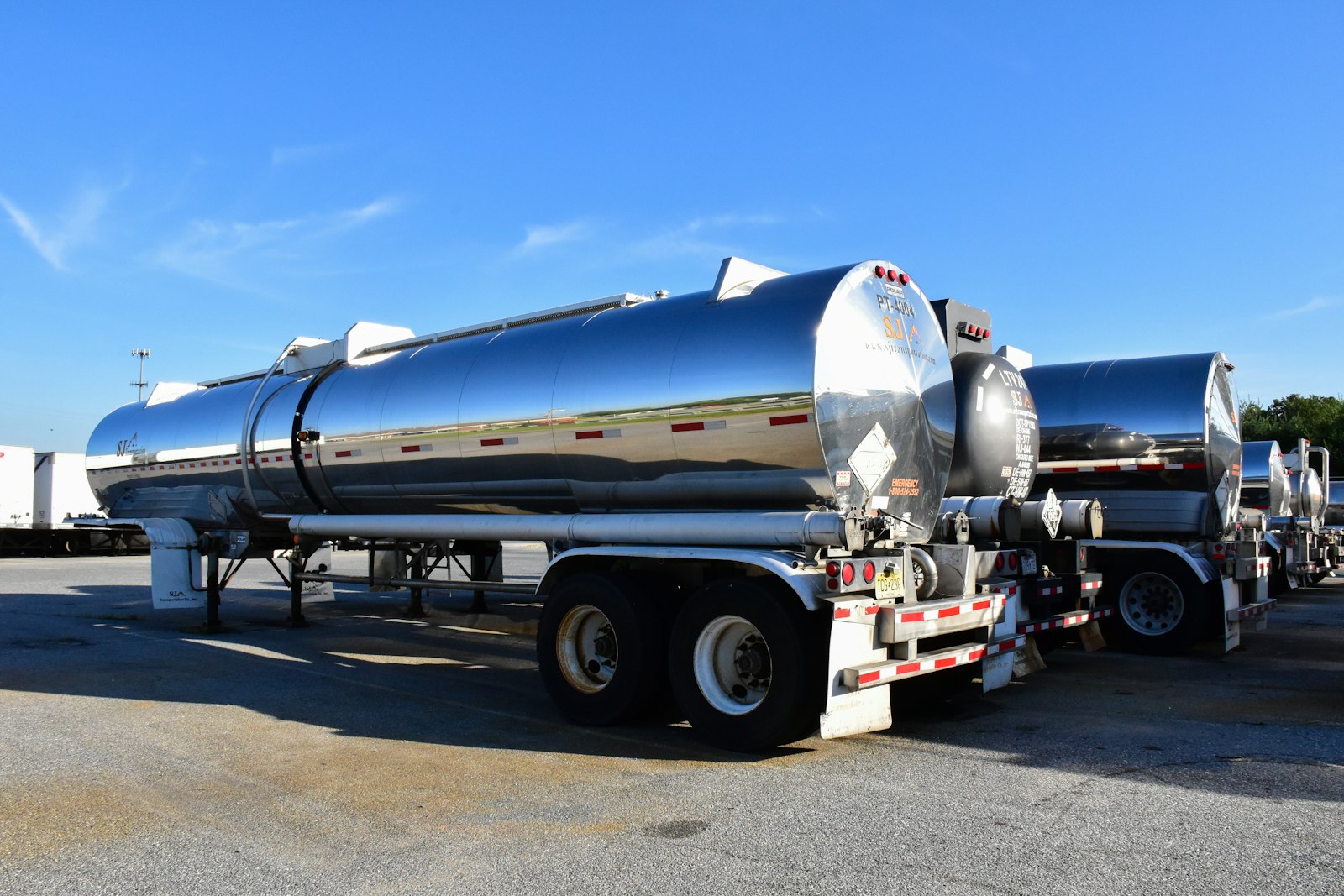
Imagine a dispatcher preparing a tank truck for its next loading. The next product is selected. The previous cargo is entered. The ePLR Check starts.
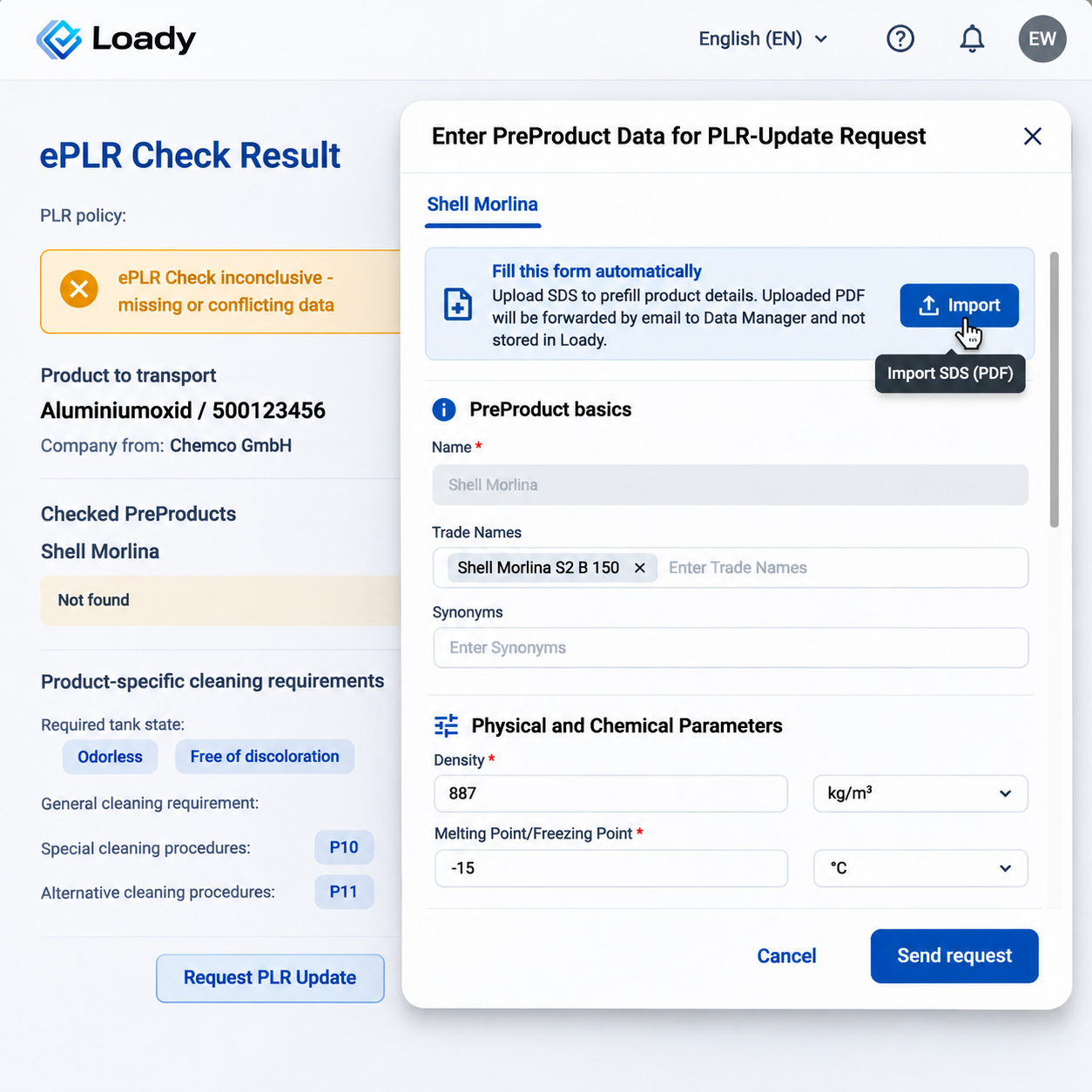
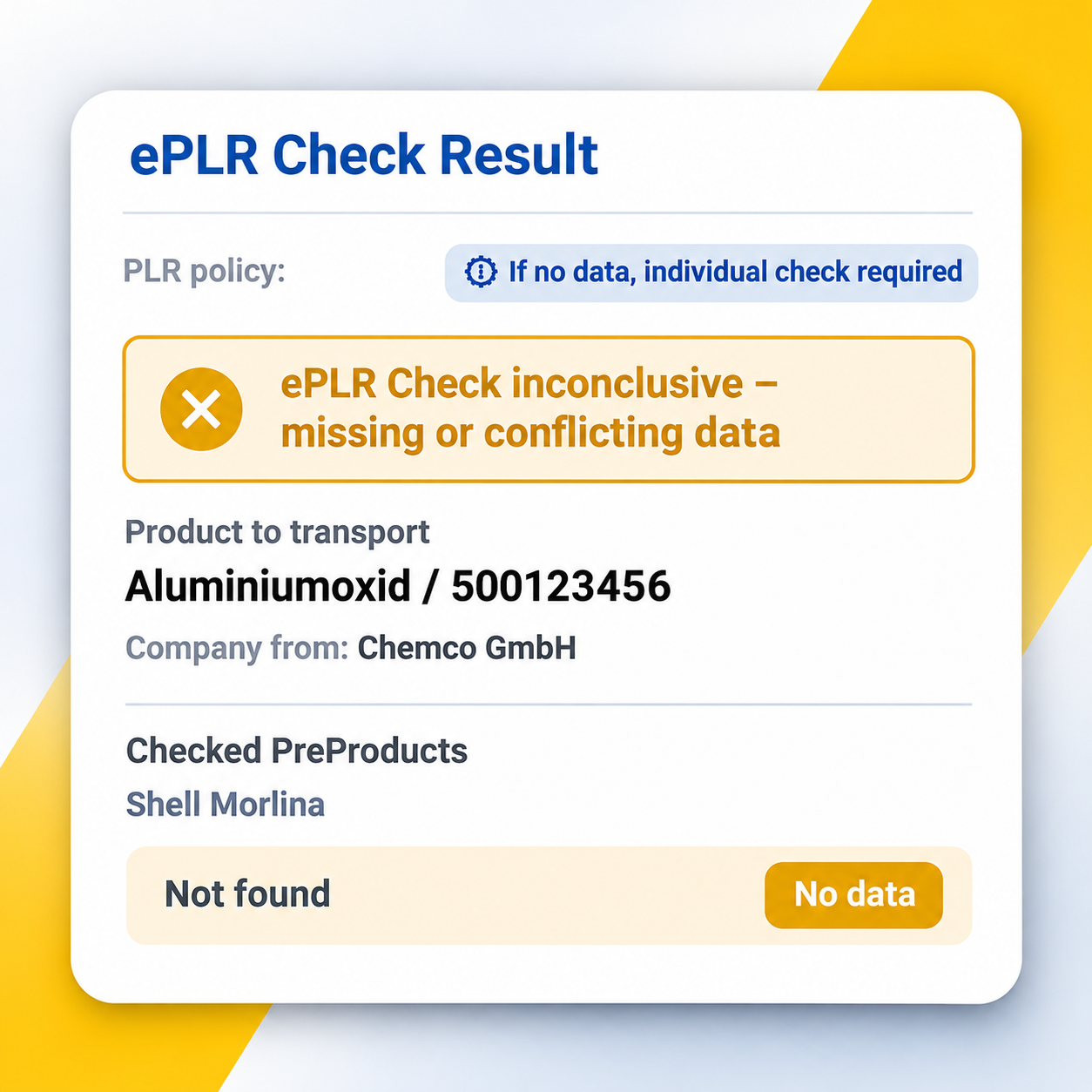
And the result is yellow. No match found.
The first reaction might be frustration. Another problem to solve. Another delay in transport planning.
But what if that yellow status is actually a sign that the system is doing exactly what it should?
No match doesn't mean not allowed
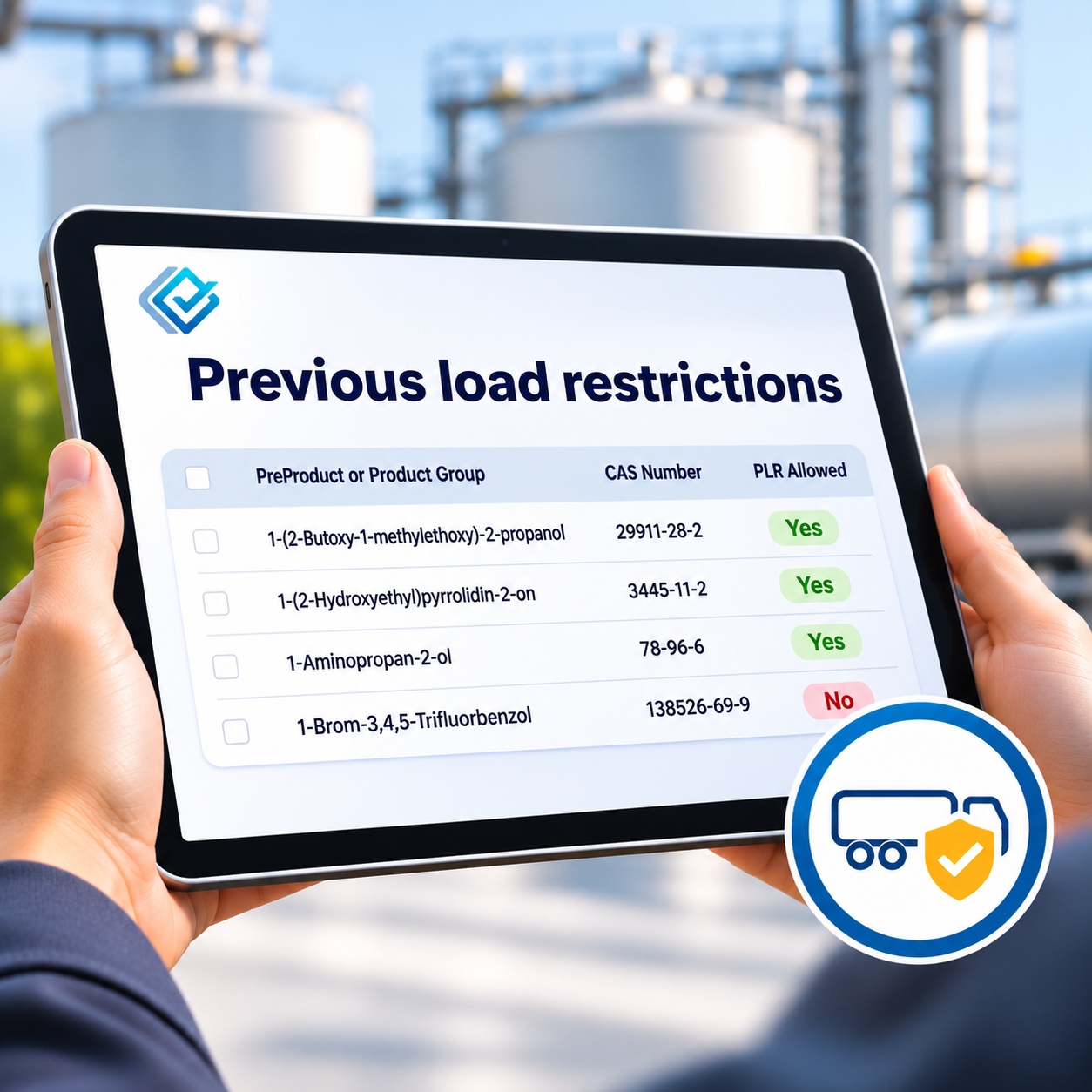
In bulk logistics, checking previous cargo restrictions is an important part of preparing a tank or silo for its next product. Depending on the product and the shipper's requirements, certain previous cargos may be permitted, prohibited or subject to specific cleaning conditions.
The Loady ePLR Check helps carriers verify these requirements digitally. But there's an important distinction between two situations:
- A previous cargo is explicitly not permitted. The applicable restriction has been identified, and the check shows red: forbidden.
- No reliable match can be established. The system cannot confidently connect the entered previous cargo with the product information and restrictions available for the check, or the available data is contradictory. The check shows yellow: a clear result is not possible.
These are not the same thing.
A missing match is not proof that the previous cargo is prohibited. But it is certainly not proof that it is permitted either. No match means the system doesn't have enough reliable information to make the decision.
And that's valuable information.
Why product matching is more complicated than it looks
Product names in logistics are anything but standardised. The same substance may appear under different commercial names, abbreviations, languages or naming conventions.
One carrier might enter a chemical name. Another uses a trade name. A third copies the product description from a previous transport document. Even small differences can complicate matching.
And not every difference is harmless. A product name may refer to a mixture, a specific formulation or a different concentration. Similar names don't necessarily mean identical products or identical previous cargo restrictions.
This creates a challenge for digital checks. A system needs to recognise genuine matches without treating every similar-looking product as equivalent. Because the consequences of a false match can be serious.
A false green result is far more dangerous than an honest yellow one. A yellow status makes uncertainty visible. A false green result can hide it.
Why guessing is not an option
AI and intelligent matching algorithms can help identify products despite differences in spelling, terminology or naming conventions. That's useful, especially when dealing with thousands of product descriptions from different carriers and shippers.
But there must be a limit to automated interpretation. If the system cannot establish a sufficiently reliable match, it should not simply choose the most plausible candidate and proceed as if the identification were confirmed.
In previous load checks, the difference between probably the same product and verified as the same product matters. This is particularly important when product-specific restrictions and cleaning requirements are involved.
A reliable digital process must therefore be able to say: We don't have enough information yet. This needs clarification.
That's not a weakness of automation. It's a necessary safeguard.
From yellow to a clear decision
Of course, identifying uncertainty is only useful if there's a practical way to resolve it. Nobody wants dispatchers to spend hours searching for product information, exchanging emails or calling different contacts.
That's why the Loady ePLR Check supports a workflow for resolving missing product information. When a previous cargo cannot be matched, the carrier can initiate a data update request. And with the latest functionality, the process has become even easier:
- The carrier simply uploads the safety data sheet (SDS) of the previous cargo.
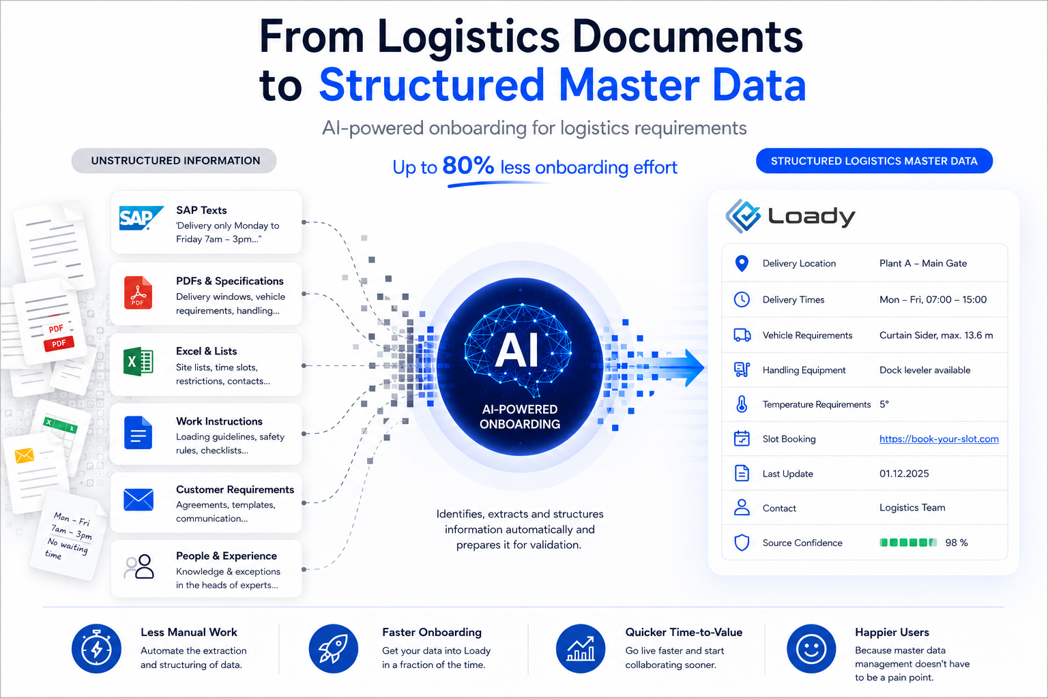
- AI extracts relevant product information from the document to support identification and data preparation.
- The carrier submits the information to the responsible Data Manager for review.
- The Data Manager evaluates the request and determines how the product should be handled within the applicable previous load restrictions and cleaning requirements.
- Once the relevant information has been reviewed and maintained, the carrier runs the check again.
The result is a controlled process rather than an uncertain assumption.
What this changes for carriers
Instead of trying to interpret an unfamiliar product name or searching for someone who knows the answer, carriers have a structured way to request clarification. The process helps to:
- reduce manual communication and repeated clarification
- make missing product information visible to the responsible Data Manager
- use AI to simplify the preparation of product data
- support consistent decisions based on maintained restrictions and cleaning requirements
- improve the availability of information for future checks
A missing match becomes an opportunity to improve the underlying data.
A yellow status can actually improve data quality
This is one of the less obvious benefits of digitalising previous load checks.
In a manual process, missing information is often resolved through phone calls, emails or individual decisions. Someone knows the product. Someone remembers a similar case. Someone asks a colleague. The transport may eventually proceed.
But what happens to the knowledge gained during that clarification? Quite often, it stays in the email conversation or in someone's head. The next dispatcher may have to solve exactly the same problem again.
A structured digital process changes that. When a missing match triggers a data update request, the information can be reviewed and maintained for future use. Over time, this helps improve product identification and the completeness of previous load restriction data.
Every resolved yellow status can make the next check easier. That's a much better outcome than simply finding a workaround for one transport.
The bigger lesson: good automation knows its limits
The discussion goes beyond previous cargo restrictions. As logistics companies increasingly rely on AI and automated decision-making, there is a temptation to measure success by how often systems produce an immediate answer. But an immediate answer isn't always the right answer.
Reliable automation must distinguish between what is known, what can be verified and what still requires human judgement. In Loady's approach, AI helps prepare and interpret information, while the responsible data owners remain in control of decisions that require operational expertise. That combination is essential for trustworthy logistics processes.
It also reflects the principle behind Logistics Execution Readiness (LER): operational requirements must be known, current, reliable and usable before a transport can be considered ready for execution.
A system that identifies missing information before loading is doing something valuable. It is making uncertainty visible at the point where it can still be addressed.
No Match? No panic.
The next time an ePLR Check returns a yellow status, don't automatically interpret it as a failure. It may simply mean that the system is refusing to make an unsupported assumption. And that's exactly what a reliable previous load check should do.
The important question isn't whether every check immediately turns green. It's whether every check leads to a trustworthy decision – or makes clear what still needs to be resolved.
Green is good when it's justified. Yellow is good when it prevents a wrong green.
Turn missing product information into reliable decisions
With Loady's ePLR Check, carriers can digitally verify previous cargo restrictions and cleaning requirements, request missing product information and use AI-assisted SDS processing to simplify data updates.
Less guessing. More transparency. Better transport readiness.
Discover the ePLR Check at www.loady.com.
Further reading
- ePLR Check: feature overview
- Glossary: Logistics Execution Readiness
- Glossary: Previous load restrictions
- Video: Loady ePLR Check