
Key takeaways
- The wave of retirements is costing logistics valuable experience. Many operational specifics, customer requirements and exceptions exist only in the heads of experienced employees.
- AI cannot replace missing knowledge. Even intelligent AI agents need reliable information about the actual conditions under which transports are carried out.
- Existing ERP data is often not enough. Historically grown free texts, outdated requirements and missing operational context make reliable automated decisions difficult.
- AI can help secure knowledge. Structuring existing information can largely be automated. Validating it professionally, however, still requires human expertise.
- Companies need a digital logistics memory. Operational knowledge must be systematically captured, structured, kept up to date and made available to people and digital systems alike.
- Knowledge management belongs on every AI roadmap. While AI technologies keep evolving, the window for securing human experience is limited.
A few thoughts on artificial intelligence, human experience and whether we are setting the right priorities in the digitalisation of logistics.
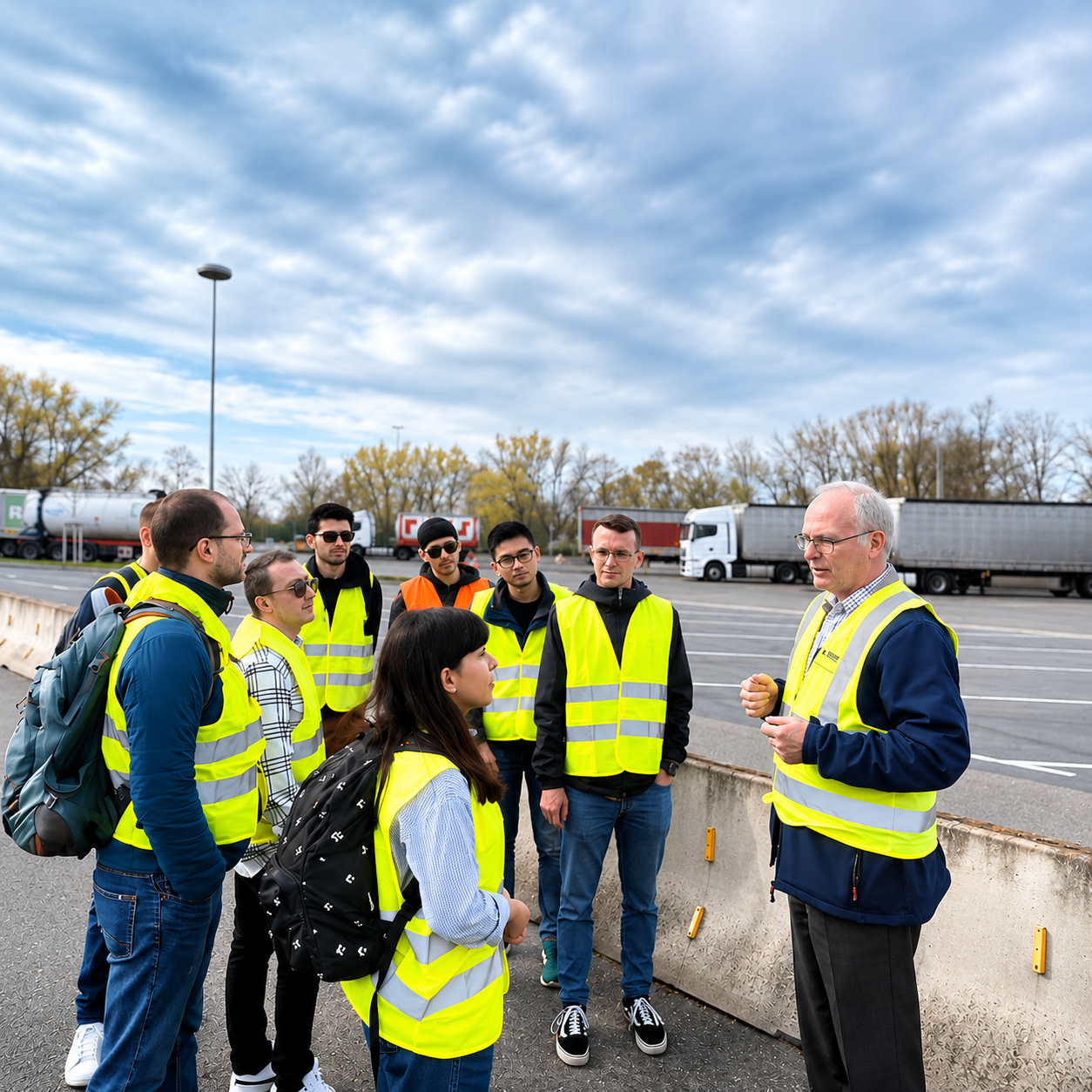
The photo is a few years old. It shows an incredibly experienced BASF logistics expert explaining to our dev team how site logistics really works in practice. Not as it is written in the process manual, but as it is lived every day at the gate, on the loading dock and in the control room.
He has since gone into a well-deserved retirement. And part of his knowledge has probably gone with him.
I have been thinking about this photo a lot lately, especially when I see presentations about AI agents and the future of automated logistics.
The people who keep our logistics running
Anyone who has worked in logistics for a while knows these colleagues. They know pretty much everything. Just mention a customer's name, and you get a detailed explanation of what to watch out for on delivery, which access road to take and why you had better not send a certain type of vehicle there.
They also know which information in SAP is no longer correct and which instructions shouldn't be taken too literally.
Over the years, they have built their own network. They know whom to call when there is a problem, and they get an answer within five minutes that would probably take a new colleague half a day to research.
Interestingly, this knowledge hardly appears in any digitalisation strategy. And yet it is often exactly what keeps our logistics processes running in the first place.
We are sometimes surprised at how well certain processes work despite poor data quality and fragmented IT landscapes. Perhaps we should be less pleased about how capable our systems are and think more about how much human intelligence it takes every day to make up for their shortcomings.
And it is exactly these people who are now gradually retiring.
An AI dispatcher can't call Peter
Given the shortage of skilled workers, many companies are pinning high hopes on AI and autonomous logistics processes. Personally, I find the idea that an AI agent could one day take over a large part of dispatching very exciting.
However, in some presentations I wonder whether those responsible have really looked at everything an experienced dispatcher needs to know to do the job well.
An AI dispatcher can't simply call the retired colleague and ask: “Hey Peter, how did deliveries to customer XY work again?”
How is it supposed to know that the customer only accepts goods until 12 noon on Fridays, even though SAP says 4 pm? That the unloading point has no loading dock, so a truck with a tail lift is needed? That the driver has to register online before arrival, or must not show up at the site more than 20 minutes before the booked time slot?
These are not exceptional special cases. This is everyday logistics.
Quantity, date, pickup and delivery address are simply not enough to dispatch a transport reliably. On top of that come opening hours, access rules, requirements for vehicles and drivers, personal protective equipment, loading and unloading equipment, documents and countless customer-specific details.
In chemical logistics, where I worked for many years, the list gets considerably longer.
An experienced dispatcher carries much of this information in their head. An AI agent has to get it from somewhere.
“But it's all in SAP.”
I hear this sentence regularly in our projects. And it's true: you find an astonishing amount of information in SAP. Sometimes even information you would rather not find there any more.
Free texts written 20 years ago. Requirements that refer to technical equipment replaced long ago. Cleaning instructions from a time when completely different cleaning methods and control mechanisms were common.
It gets particularly interesting when you try to find out who originally wrote these texts and why.
Quite often it turns out that the colleague in question has been retired for years. His successors have taken over the requirements but don't necessarily understand the reasons behind them. And especially when safety or product quality is at stake, understandably nobody dares to simply change or delete such a requirement.
So it stays.
The carrier may have stopped following it long ago because, from their point of view, it no longer makes sense. The colleagues at the loading point, on the other hand, assume that everything is defined correctly and the requirements are being met.
As long as nothing goes wrong, hardly anyone questions this state of affairs.
And now we want to use exactly this data as the basis for intelligent, automated decisions.
I'm not sure we are all aware of what we are, in some cases, trying to automate.
What we have learned at Loady from working with AI
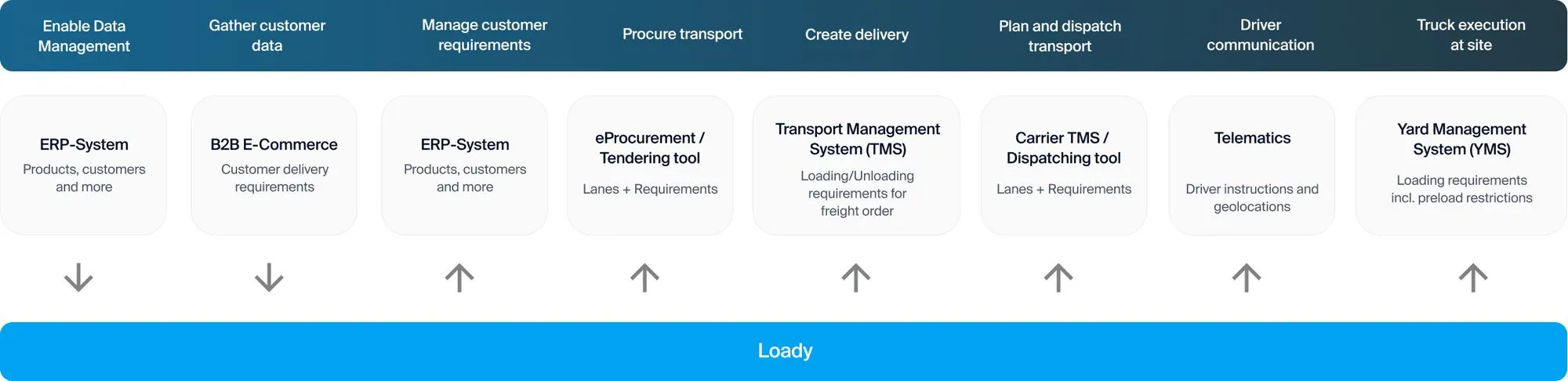
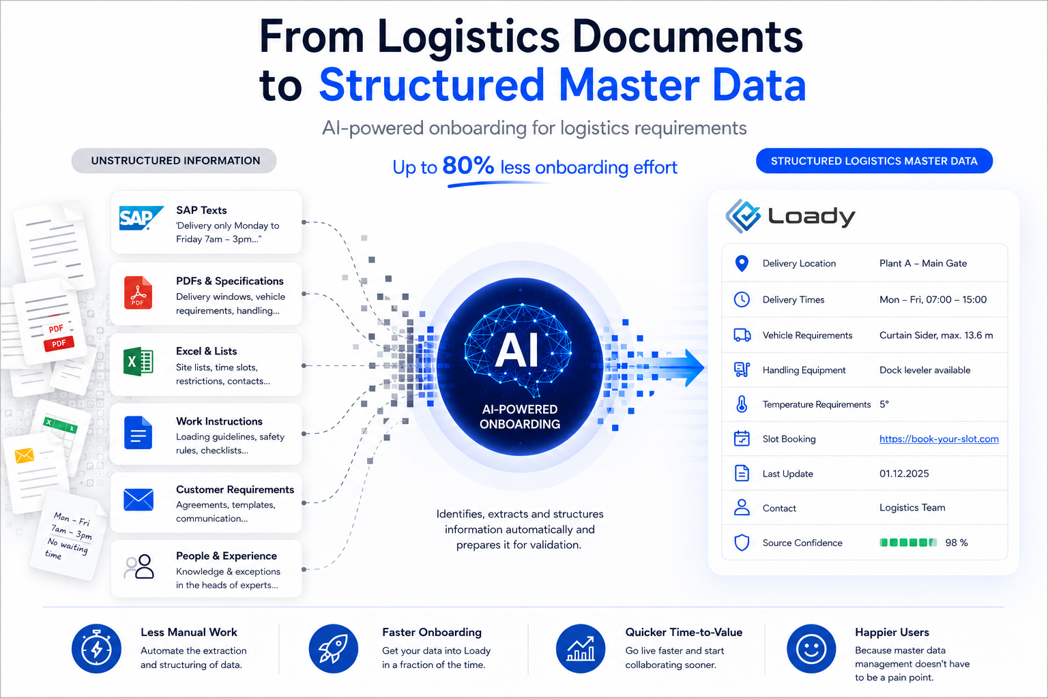
At Loady, we use AI to transfer unstructured logistics requirements from Excel files, documents and ERP free texts into our standardised data model.
What AI can do here today really excites me. Work that used to take a lot of time and manual data entry can now be automated to a large extent.
In our projects so far, however, around 10–20% of the free texts are always left over where we need human support.
And the interesting thing is this: often it's not that the AI doesn't understand the text. Sometimes we humans don't understand it either.
The information is incomplete, contradictory or obviously outdated. Sometimes the crucial context is missing. Sometimes it's not clear whether a requirement applies to the entire site or only to a specific loading point.
Then we need someone who knows the operational process and can decide what should happen with this information.
Which brings us back to Peter.
As long as Peter is still with the company, we can work with him to clean up this data, question requirements, fill in missing information and put his knowledge into a form that other people and digital systems can use as well.
Once Peter has retired, that becomes much harder. And probably much more expensive.
We invest in artificial intelligence and let human intelligence retire
What puzzles me somewhat about the current development is how differently these two topics are treated.
For AI, strategies are developed, budgets allocated, innovation teams set up and ambitious roadmaps presented.
But how many companies actually have a comparably ambitious strategy for securing the operational experience of their employees?
Is there a budget for it? Is anyone responsible? Do experienced colleagues even get the time to pass on their knowledge and document it properly together with others?
Or are they expected to do it somehow alongside their day-to-day work, while also solving the problems nobody else can solve?
I sometimes get the impression that in digitalisation we think a great deal about how technology can relieve people, and surprisingly little about what we still need to learn from these people before they leave the company.
If an IT manager ran a business-critical database without a backup, they would probably be in serious trouble.
Yet a company storing business-critical knowledge in the heads of individual employees for decades seems to be an accepted normal state in many places.
Companies need a digital logistics memory
That is why I have been thinking more and more about how companies could build their own digital logistics memory.
I don't mean interviewing every experienced colleague before they retire, recording the conversations and then dumping a few thousand pages of documentation on SharePoint.
That would merely create yet another information source in which, sooner or later, nobody can find their way around.
What matters to me is capturing and structuring operational knowledge where it will actually be needed later.
If an experienced colleague knows that a particular unloading point can only be served by a vehicle with a tail lift, this information should be stored as a specific vehicle requirement for that unloading point.
If he knows that a customer has different receiving hours on Fridays, this information belongs in the structured opening hours of the customer's site.
And if he can explain why a particular requirement was introduced years ago, we should record that background too, so that his successors can later judge whether the requirement is still relevant.
Of course, this is work. And not just for IT.
It takes people from operations who contribute their knowledge, review existing requirements and take responsibility for keeping them up to date.
With Loady, we are trying to build exactly this kind of digital logistics memory, at least for operational logistics requirements, one that can also be used across company boundaries.
By the way, it is not only future AI agents that benefit. New employees, carriers, dispatchers and drivers would already have a much easier life today if they weren't constantly searching for information or for the right contact person.
Perhaps we should rethink our AI roadmaps
I would like to see companies, when planning their AI projects, think not only about which processes they want to automate, but also about what knowledge this requires and where that knowledge sits today.
And if the answer is that a significant part of it sits in the head of a 63-year-old colleague, I would set priorities accordingly.
Not every AI use case has to be implemented right away. The technology keeps evolving, the models are getting better, and many solutions will probably be cheaper and easier to implement in a few years.
When it comes to securing our human experience, we don't necessarily have that luxury of time.
I am still excited about the opportunities AI opens up for logistics. But I believe we are currently at risk of creating a considerable imbalance between our investment in the technology and our investment in its knowledge base.
We are building beautiful AI castles in the air and hoping the foundation will somehow sort itself out.
Otherwise, one day we will have incredibly intelligent AI agents that unfortunately have no idea how to dispatch a truck reliably.
Peter could have explained it to them.
Related entries
- AI-Ready Logistics Data
- Master Data in Logistics
- Master Data Management (MDM)
- Data Governance
- Loading and Unloading Instructions

Frequently asked questions
What is a digital logistics memory?
A digital logistics memory is a structured, continuously maintained knowledge base for operational logistics processes. It includes, among other things, site rules, customer requirements, loading and unloading conditions, vehicle specifications, safety requirements and product-specific restrictions. The aim is to make valuable experience-based knowledge permanently available to people, IT systems and AI agents, independently of individual employees.
Why does the wave of retirements threaten the digitalisation of logistics?
Many experienced logistics employees have built up knowledge over decades that was never systematically documented. When they leave, companies lose not only skilled staff but also knowledge of operational specifics, exceptions and customer-specific requirements. Yet this knowledge is an important basis for automating logistics processes.
What data does an AI agent need for transport planning?
In addition to standard transport data such as quantity, weight, date and pickup and delivery address, an AI agent needs detailed operational logistics requirements. These include opening hours, access rules, vehicle requirements, loading and unloading equipment, safety regulations, document requirements and product-specific restrictions. This information must be current, reliable, structured and clearly assigned to the relevant operational context (see AI-Ready Logistics Data).
Can AI replace missing experience-based knowledge in logistics?
AI can analyse, interpret and structure existing information. However, it cannot reliably reconstruct missing experience-based knowledge or decide on its own which contradictory or historically grown requirements are still valid. This still requires people with operational experience and the expertise to make decisions.
Why is logistics data in ERP and TMS systems often not enough for AI agents?
ERP and transport management systems contain important order, master and planning data. However, operational requirements are often stored in unstructured free text, in separate documents or not documented at all. Information may also be outdated, incomplete or contradictory. For reliable automated decisions, AI agents need a validated and structured data basis that also reflects the actual conditions of transport execution.
How can companies secure their operational logistics knowledge in the long term?
Companies should systematically capture their employees' experience-based knowledge, review existing requirements and convert them into structured data. Clear responsibilities for maintaining and updating the information are essential. Platforms such as Loady support this process by standardising operational logistics requirements and making them available across companies to people and digital systems.