December 3, 2025 - Loady's new position paper analyzes the current situation with fragmented data and demonstrates how structured previous load restriction data can improve inspection processes in the chemical, feed, and food industries, leading to gains in efficiency and sustainability.
Unified data model replaces manual checks.
Loady structures previous load restrictions within a chemically and logistically consistent data model. Each substance is uniquely identified by CAS and EC numbers, synonyms, and multilingual designations. Rules can be defined at the substance or group level and return clear statuses. Companies manage their restrictions centrally in Loady and can import existing lists in a structured manner. The platform offers API interfaces for synchronization with ERP and QHSE systems, as well as export functionalities. The use of structured previous load restriction data reduces manual inspection efforts by up to 80%, prevents rejections through valid dispatching, and lowers CO₂ emissions by reducing multiple trips and unnecessary cleanings.
The solution is used at three levels: Dispatchers, shippers, and cleaning companies check whether product combinations are permissible and which cleaning procedures are required. Forwarders and shippers perform structured Previous Load Restriction Checks (ePLR) by entering up to five previous loads and immediately receiving validated results. Pilot customers integrate the ePLR logic into transport and yard management systems for automatic checks before dispatch or gate release.
Future integration into electronic cleaning certificates
Loady is working on integrating the ePLR logic into electronic cleaning certificates such as ECLIC's eECD or Bulkvision certificates. In the future, cleaning certificates could be automatically checked against valid previous load restrictions – the cleaning station transmits the previous product and cleaning code, Loady validates the information and records the inspection result directly in the certificate. The whitepaper is available for free download at the following URL: Link
You might also be interested in this
Presse
Neuigkeiten
2026-08-31
Loady Developer Portal is live: Taking integration to the next level
Loady is already being integrated directly into the system landscapes of companies and carriers today. With every new integration, the importance of simple, transparent, and scalable technical collaboration continues to grow.
With the new Loady Developer Portal, we are now creating the common foundation for this.
From data maintenance to operational processes
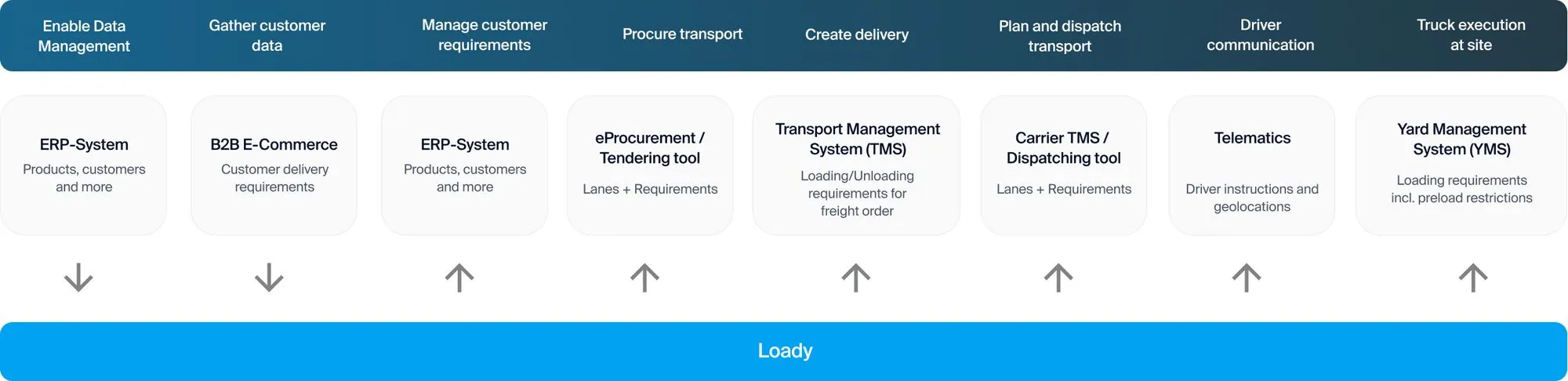
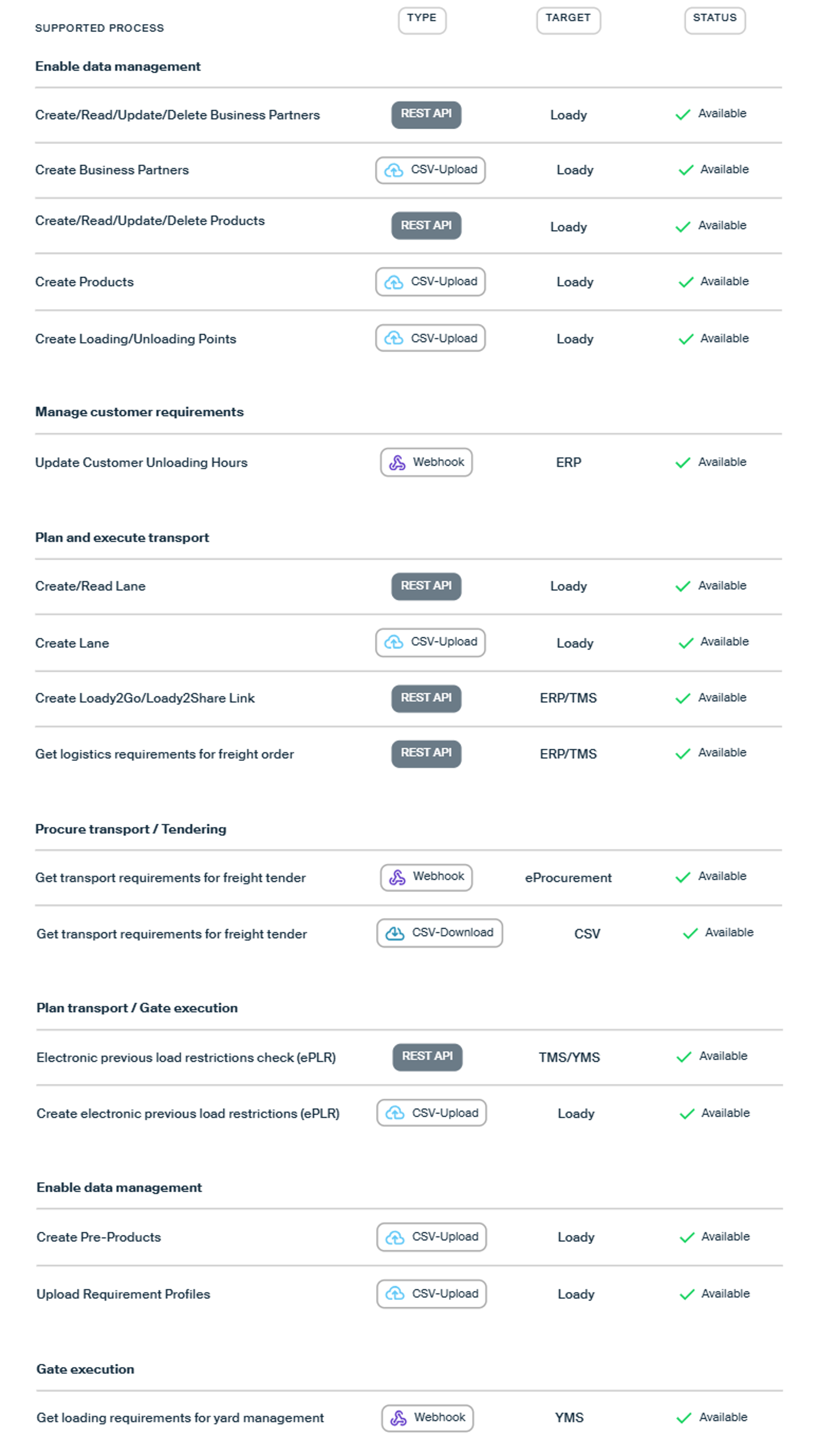
Loady already offers a multitude of APIs and webhooks to make structured logistics master data available exactly where it is needed.
For example, companies can synchronize master and logistics data between Loady and their ERP or TMS systems, retrieve current logistics requirements directly for transport orders, or incorporate tender data into their e-procurement processes. ePLR checks and the provision of data for yard and gate processes can also be integrated directly into operational workflows.
For carriers, integration with Loady opens up the possibility of importing current requirements directly into their TMS, planning, dispatch, or other proprietary applications and reliably passing them on to the parties involved in the transport process.
The goal: stop copying, transferring, and manually updating information between systems – and instead make reliable data available exactly where it is needed in the process.
The new portal provides a central entry point for development teams
The more integrations that are created, the more important simple and professional collaboration between the involved development teams becomes.
That is exactly what the Loady Developer Portal is for.
It consolidates the technical documentation for our Customer APIs in one central location and guides developers from their first steps through to productive integration. This includes, among other things:
central and up-to-date API documentation
clear API references
getting-started and authentication guides
documentation for webhooks and API conventions
a playground environment for developing and testing integrations
versioned interfaces for reliable ongoing development
This allows developers to find their way around faster, prepare integrations more effectively, and resolve technical questions transparently during implementation.
This also marks an important step for our collaboration: instead of exchanging documents individually and sharing technical information across various channels, everyone involved now works from a shared, up-to-date technical foundation.
APIs turn logistics master data into process data
For us, this developer portal is therefore more than just a new documentation page.
Structured logistics master data only truly delivers value when it doesn't remain trapped in a single system. It needs to be available for transport planning, dispatch, freight procurement, yard and gate processes, and all logistics partners involved—kept up-to-date, structured, and digitally accessible.
The more companies and carriers integrate Loady directly into their systems, the more industrial logistics benefits from a common data foundation that can be used across company and system boundaries in digital logistics processes.
List of available APIs
As of 08/31/2026
Would you like to connect Loady to your ERP, TMS, yard management system, driver app, or another application? -
More than 80% less effort in freight tender preparation
Customer case from logistics procurement demonstrates significant time savings through standardized logistics requirements
Less than two hours insteadof two working days: Around 150 freight lanes were prepared and transferred tothe company's freight tender platform in a fraction of the previous time.
Less manual data collection, higher data quality: All relevant logistics requirements were already available in a structured, up-to-date and digitally reusable format.
Mannheim, July 14, 2026. Preparing freight tendersstill requires considerable manual effort in many companies. Logistics requirements have to be collected from different sources, verified, coordinated and prepared for tender platforms.
A recent customer case from a Europe-wide freight tender illustrates the potential of standardized and centrally maintained logistics requirements. As part of a cross-business freight tender, one business unit had to contribute around 150 freight lanes to the tender process. All required information was compiled directly from the existing Loady data repository and transferred to the tender platform, including ERP references, assigned carriers and validity periods.
"What previously would have required almost two full working days of preparation was completed in less than two hours," says Maik Anderssohn, Order-to-Delivery and Logistics Procurement, Chemical Intermediates at BASF SE. "The biggest difference for me was that all the required information was already complete and structured. Previously, I had to gather information from many different sources, compare it and verify it several times. It was always time-consuming and tedious."
Maik Anderssohn - Order-to-Delivery und Logistics Procurement Chemical Intermediates bei BASF SE
The simple and intuitive user experience was another major advantage. Relevant freight lanes could be identified quickly using filter functions and prepared directly for the tender process – without additional training or complex intermediate steps.
The standardized approach also benefits logistics service providers. Logistics requirements can be processed digitally right away – either by downloading the data or via existing system integrations. This reduces manual clarification, coordination effort and rework throughout the entire tendering process.
"These are exactly the kinds of processes we wanted to simplify with Loady," says Stefanie Kraus, Co-Founder and CEO of Loady. "Transport and site requirements still createa tremendous amount of manual work in many organizations today. From the very beginning, our goal has been to make these logistics requirements centrally available and reusable in a standardized way. Receiving such positive feedback from daily operations is particularly rewarding. It confirms that standardized logistics requirements create real value in day-to-day logistics."
About Loady
Founded in 2023 in Mannheim, Germany, Loady provides the foundation for the next generation of digital logistics processes. By standardizing and digitally providing logistics requirements, Loady enables their seamless use across the supply chain – from freight procurement and transport planning to execution, delivery and compliance. In doing so, Loady transforms logistics knowledge into a digital resource for efficient collaboration, automation and AI-powered processes. Today, Loady provides logistics requirements for more than 22,000 products and 500 sites across Europe, the United States and Canada.
Strategic Partnership: Cargoclix and Loady partner on logistics data and process integration
· The Mannheim-based startup Loady and software provider Cargoclix will link their systems in the future to more closely integrate master data and operational logistics processes.
· The topic of time slot management was the starting point for the joint discussions.
Freiburg i.Br./ Mannheim, July 8, 2026. The Mannheim-based startup Loady and Freiburg im Breisgau-based software provider Cargoclix will cooperate in the future as part of a strategic partnership to link logistics data and operational processes along the supply chain. Today, companies already use Loady to digitally exchange logistics requirements for over 20,000 products, 500 locations, and delivery information from over 50,000 business partners with their transport partners. Cargoclix brings over 25 years of experience in digitizing operational logistics processes and currently has over 200,000 users and more than 3,000 customer locations worldwide. The company's portfolio includes time slot management, digital driver and site processes, as well as transport and tender management.
The discussions between the two companies began with the topic of time slot booking. Further exchanges revealed that the commonalities also extend to digital driver processing, site communication, and transport and tender processes.
"Loady creates a unified data basis for logistics requirements, from which our customers can benefit," says Prof. Dr. Victor Meier, advisory partner at Cargoclix. "For time slot, yard, and driver processes, the availability of standardized information reduces queries and delays. We see potential in this for our joint customers," he emphasizes.
For Loady, this collaboration is also a decision against developing its own time slot management solution. "We are regularly asked why Loady doesn't offer its own slot booking," says Stefanie Kraus, CEO and co-founder of Loady. "The answer: providers like Cargoclix have been successfully advancing this topic for many years. Our goal is to make the right solutions accessible to our customers for their processes, instead of duplicating functionality."
Many customers of both companies already use Cargoclix solutions in parallel for transport management, freight procurement, and site handling, as well as Loady for data exchange along the supply chain. Both companies intend to expand their collaboration in the coming months and develop joint integration and application scenarios for their customers.
About Loady
Mannheim-based Loady GmbH, founded in 2023, lays the foundation for the next generation of digital logistics processes. By standardizing and digitally providing logistics requirements, Loady enables their cross-system use along the supply chain – from freight procurement, through commissioning and dispatch, to delivery and control. This transforms logistics knowledge into a digital resource for efficient collaboration, automation, and the use of AI. Today, Loady already provides logistics requirements for over 20,000 products and 500 locations in Europe, North America, and Latin America, available in 17 languages.
About Cargoclix
Cargoclix is a leading provider of digital solutions for transport and logistics processes. Since 1998, the company has supported industry, trade, and logistics service providers in digitizing their processes simply, efficiently, and end-to-end – from strategic freight procurement and transport management, through delivery planning, to the control of vehicles, drivers, and operations on the factory premises.
Today, over 200,000 users utilize Cargoclix solutions at more than 3,000 locations worldwide. All products are available as Software as a Service (SaaS) in the cloud. Thanks to their modular design, companies can start with individual processes and gradually expand the digitalization of their logistics.
Contact for inquiries: Cargoclix - Dr. Meier & Schmidt GmbH Johannes Schmidt, Münsterplatz 11 / im Kornhaus, D-79098 Freiburg i.Br., T +49 (0)761 205511-02, E-Mail: presse@cargoclix.com
impact media projects Stefanie Nonnenmann, Eckherstraße 10 b, 85737 Ismaning, T +49 (0)89 2153846-13, Email: stefanie.nonnenmann@impact-mp.de