From SULID documents to standardized digital logistics data
How Loady is evolving the SULID concept from harmonized documents into universal, multilingual, and interoperable data for chemical logistics
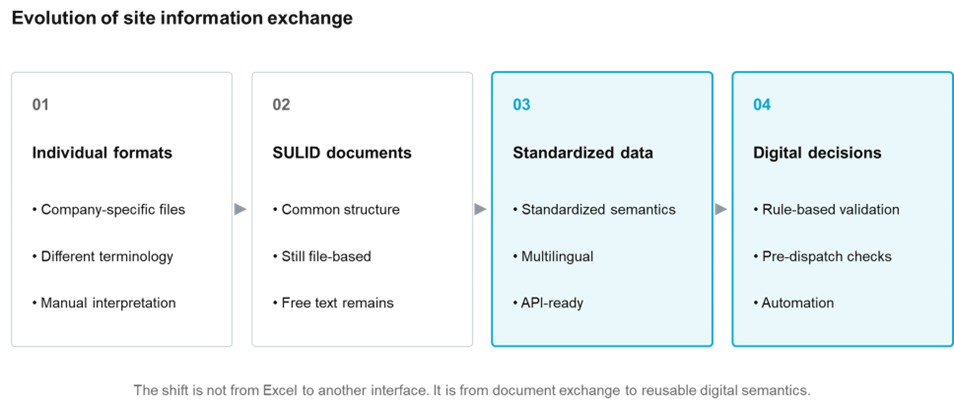
SULID took a major step toward harmonization in chemical logistics by creating a common structure for loading and unloading information. It allowed companies to ask comparable questions and capture site requirements using a shared schema. However, harmonizing a document is not the same as standardizing the data it contains.
Document-based information remains trapped in individual files that are exchanged and copied between parties. Multilingualism means separate document versions. Different terminologies and free-text fields still require human interpretation. Especially in complex chemical transport, the intended level of detail is not always sufficient to clearly map technical and operational requirements digitally.
This becomes a problem as soon as the information needs to be used digitally rather than just read. TMS, ERP, procurement, scheduling, and yard management systems require clear, machine-readable data. A human can infer which coupling, hose length, or pump equipment is required from a comment, for example. An IT system, however, needs standardized objects, values, and attributes to process the same information reliably.
Loady therefore advances the SULID concept from document harmonization to data standardization. Complex loading and unloading requirements are converted into standardized, multilingual, and interoperable logistics data—at the level of detail required by the specific use case. Information can be provided centrally, shared with authorized partners, and integrated directly into operational systems and processes via interfaces.
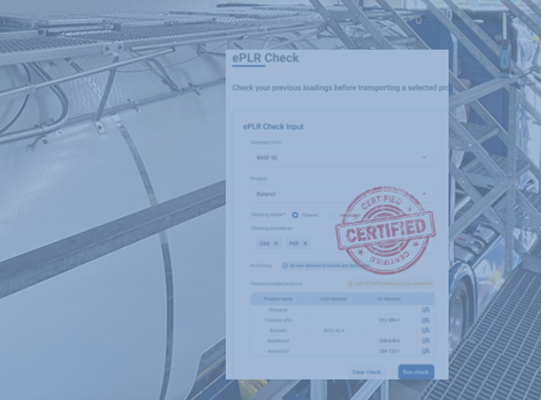
The potential of this approach is particularly evident in complex liquid bulk transport. Pre-loading restrictions can not only be documented but also mapped digitally as structured rules and cross-referenced with a tank's actual pre-loading history. The Loady ePLR Check thus enables rule-based verification before scheduling—exemplifying the shift from digitally available information to digitally usable decision logic.
This whitepaper highlights the limitations of document-based SULID solutions, explains the difference between standardized data and harmonized documents, and outlines the new opportunities this creates for integration, data quality, and automation in chemical logistics.
SULID took a major step toward harmonization in chemical logistics by creating a common structure for loading and unloading information. It allowed companies to ask comparable questions and capture site requirements using a shared schema. However, harmonizing a document is not the same as standardizing the data it contains.
The crucial difference
SULID created a common structure for asking the questions. Loady creates a common digital language for presenting, sharing, and utilizing the answers.
Chemical logistics requires the exchange of highly specific information between many organizations. Before a transport can take place, carriers and drivers may need to understand the following:
· Site access and registration requirements
· Personal protective equipment (PPE)
· Loading and unloading procedures
· Connections, couplings, hoses, pumps, and compressors
· Vehicle and tank equipment
· Pressure and temperature requirements
· product-specific restrictions and safety procedures
· Operating hours and driver instructions
· processes and operational instructions to be followed
Historically, this information was communicated via company-specific questionnaires, safety instructions, emails, and other documents. SULID was created in 2011 to improve this situation. The 2013 Cefic/ECTA Best Practice Guidelines explicitly state that SULID 2011 was developed in collaboration between Cefic, ECTA, and FECC and was available for liquid, bulk, and packaged goods. They also describe SULID primarily as an information document.