Does every freight order know what applies at the loading point?
And can your TMS, or an AI agent, work with it?
Data for freight orders delivers all loading and unloading requirements directly with the transport order: structured, up to date and machine-readable. For dispatch, carriers, drivers, TMS and AI agents.
Maintained once. Handed over with every order. Usable by people and AI.

The order is sent digitally.The requirements still arrive by PDF, email and phone.
What applies at loading and unloading points sits in documents, inboxes and people's heads, often in several versions and not machine-readable.
Dispatch, carriers and drivers copy the information by hand into every single order. Systems and agents don't get it at all.
Ready to go in three steps.
You maintain the requirements once. Loady attaches them to every order that involves this loading or unloading point.
Maintain
Capture requirements per loading and unloading point in Loady, or take them over from your customers' and partners' Loady network.
Link
Connect freight orders with loading and unloading points, via interface from ERP or TMS or directly in Loady.
Hand over
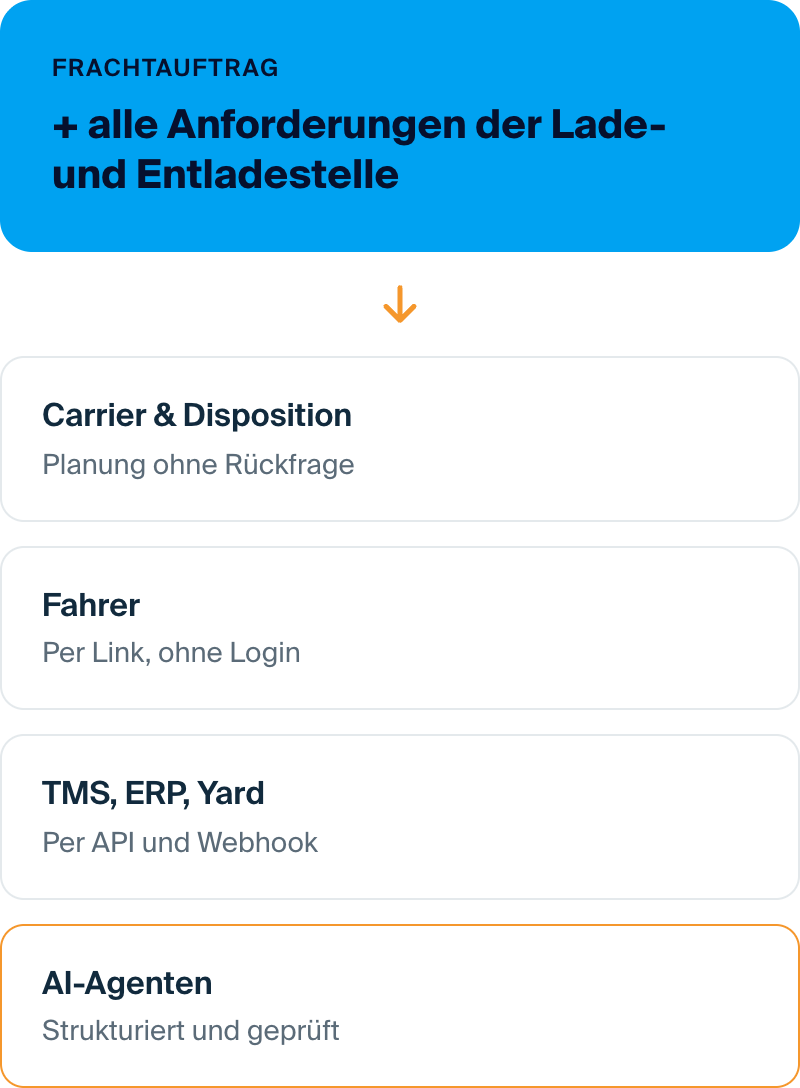
The requirements travel with the order to carriers, drivers, systems and agents, always in the current version.
Requirements as data, not as attachments
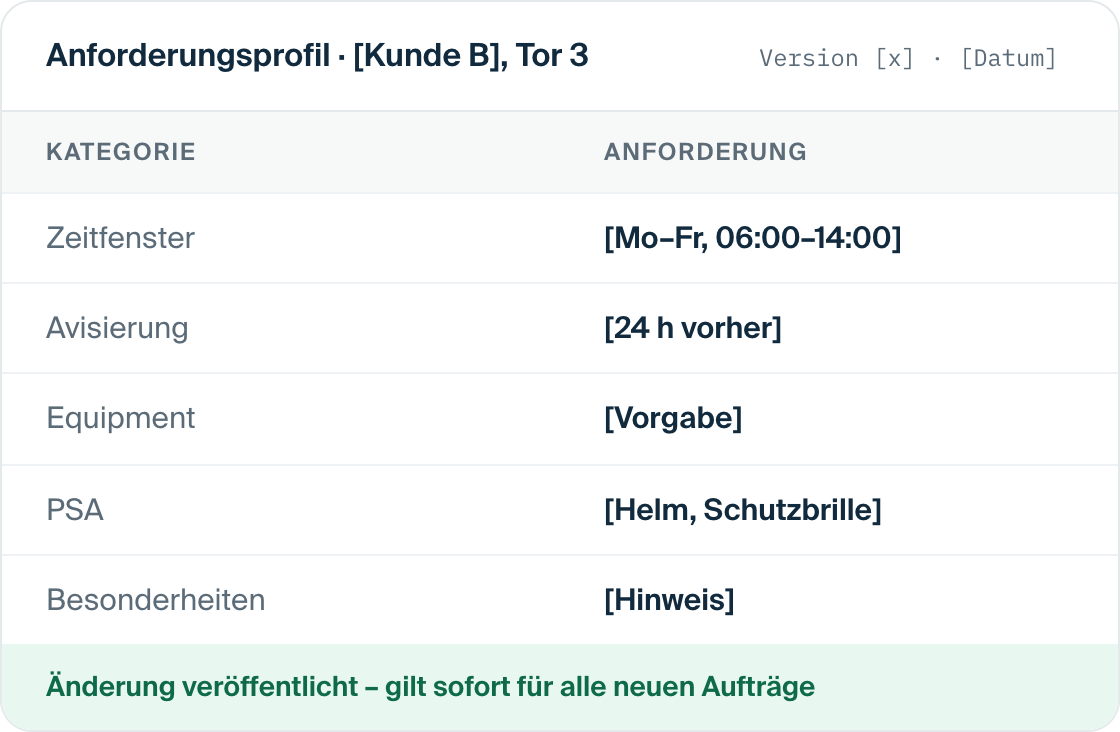
Time slots, pre-notification, equipment, PPE, documents and special notes live in a standardized data model, for liquid, bulk and general cargo.
When something changes, you update it in one place. Every new order automatically gets the current version.

Everyone involved gets what they need, with the order
You decide who sees which data. Everyone works with the same version.


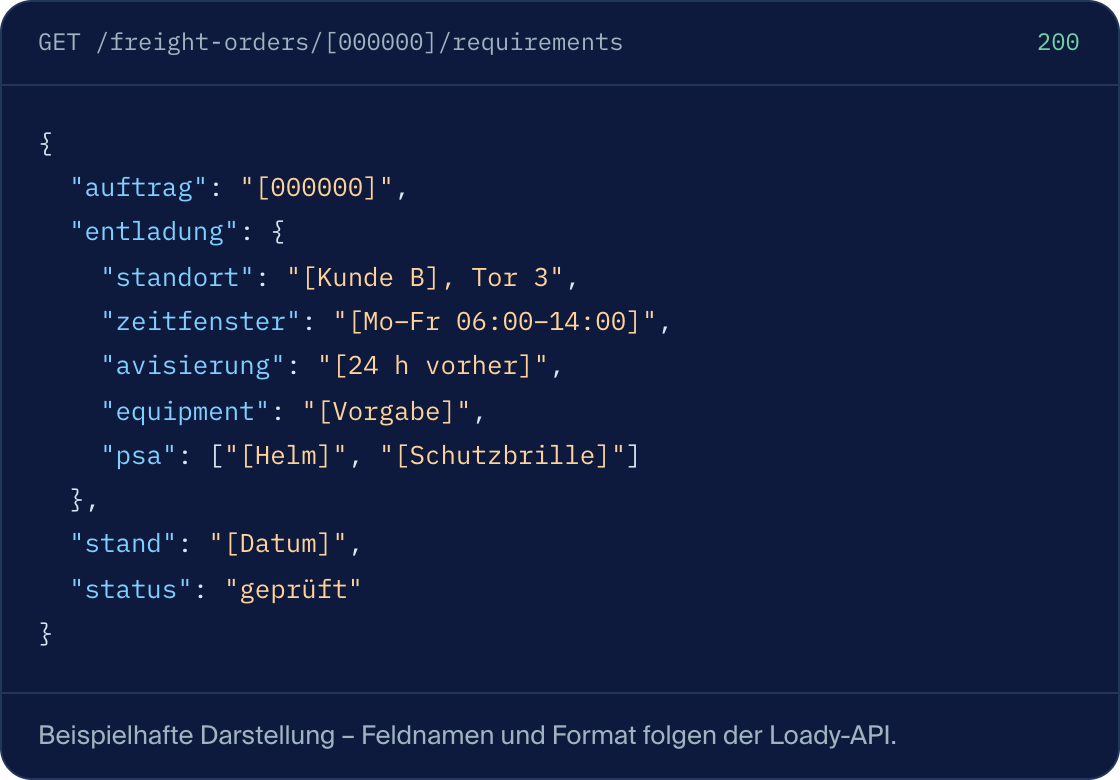
Agents don't ask. They look it up.
AI agents and automations can only work with data that is structured and reliable. With data for freight orders, that's exactly what they get, instead of guessing requirements from PDFs and emails.

For everyone who plans, executes or automates transports
Frequently asked questions
About data for freight orders.
Excel and SharePoint can work well for maintaining Previous Load Restrictions internally. The challenge begins when these rules need to be applied consistently by carriers, loading and unloading sites, and external logistics partners.
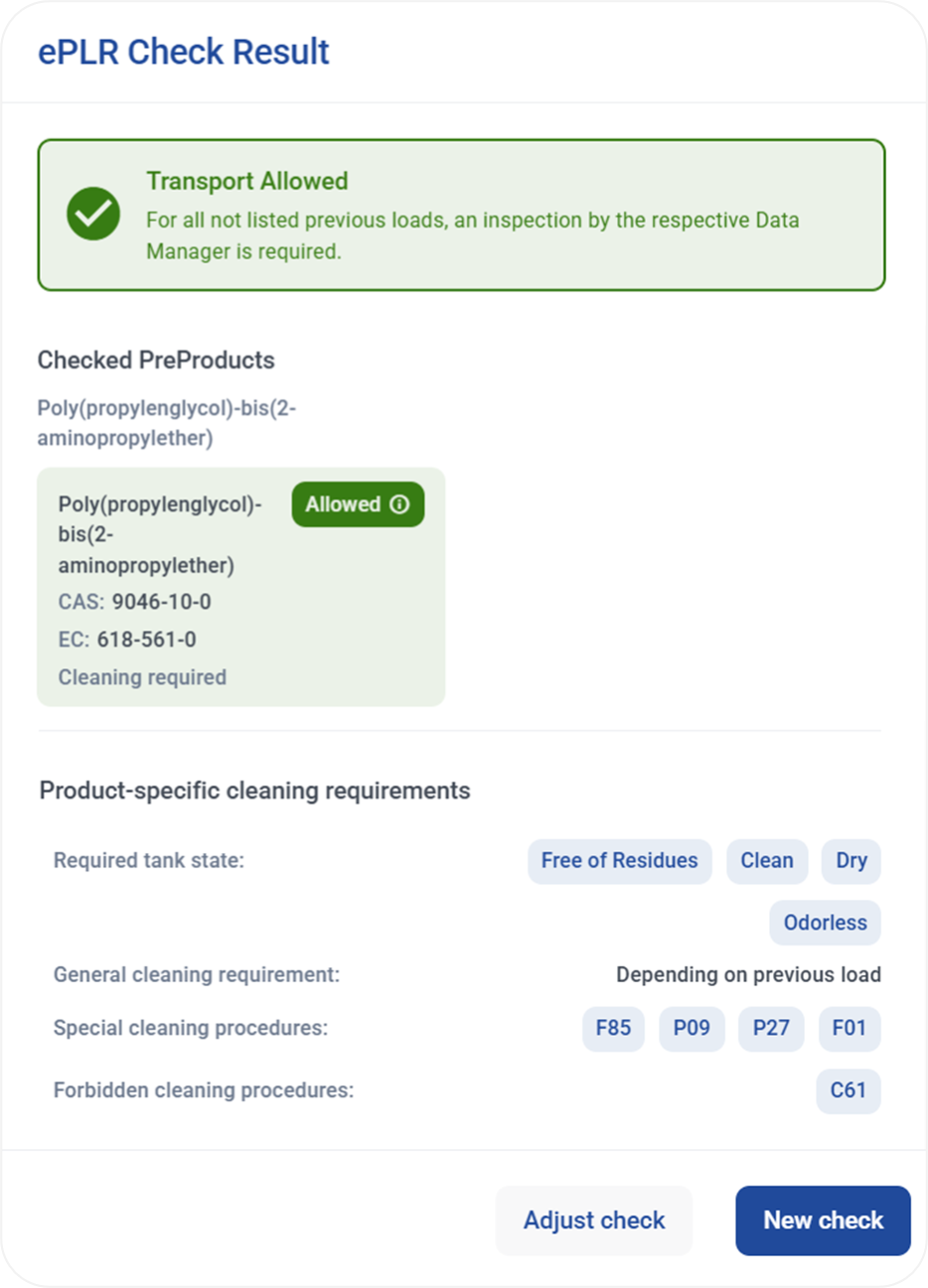
ePLR Check transforms existing Previous Load Restrictions and cleaning requirements into structured, digitally checkable rules. Updates become immediately available to authorized partners, eliminating the need to distribute revised lists or manually interpret customer-specific restriction matrices.
Yes. Carriers can check whether a previous load is acceptable for the next product and see which cleaning procedures are required – before assigning equipment or arranging cleaning.
This helps dispatchers select suitable tanks, plan the necessary cleaning, avoid unnecessary cleaning operations and reduce the risk of truck rejections during loading or unloading.
No. Chemical companies can get started simply by uploading their products, Previous Load Restrictions and cleaning requirements. AI-supported data onboarding and matching against existing product data make it easier to import and structure this information.
Authorized carriers, loading and unloading personnel, and external tank terminals can then use ePLR Check directly online.
At loading or unloading, ePLR Check verifies both previous-load compatibility and whether the required cleaning conditions have been fulfilled.
Integration with TMS, yard management or gate systems is possible, but not required to get started.
Gate personnel and staff at loading or unloading points can use ePLR Check directly online – just like carriers. Everyone checks against the same set of rules maintained by the chemical company.
The check verifies not only whether the previous load is permitted, but also whether the required cleaning conditions have been fulfilled. Previous checks can be reviewed in the check history, making it possible to see whether the carrier has already performed the check and what the result was.
With the integration of ePLR Check into ECLIC's electronic cleaning document (eECD), this process will become even easier. Digitally documented previous-load and cleaning information can be used directly to validate compliance with the manufacturer's requirements, increasingly eliminating the need for repeated manual checks.
One set of rules, consistent decisions and a traceable check history – from dispatching to loading and unloading.
Getting started is straightforward and requires no integration with existing IT systems: Upload your Previous Load Restrictions, authorize your carriers – and you're ready to go!
Existing restriction lists and cleaning requirements can be imported with AI support, structured and matched to the relevant products and product groups.
With Loady's support, hundreds of Previous Load Restrictions can be digitized and made available for automated checks within just a few days.
Once the data is ready, simply authorize your carriers and logistics partners. They can immediately access the latest rules and start using ePLR Check for dispatching, loading and unloading operations.
No complex IT implementation, no lengthy projects – get started in just a few days.
Give every freight order the data it needs.
We'll show you with an example order how data for freight orders fits into your process.