From freight tendering to scheduling, all requirements are standardized, stored centrally and updated at all times. Charging requirements, safety requirements and pre-charging restrictions are clearly defined, available in multiple languages and automatically synchronized. Changes are transferred seamlessly — no misunderstandings, no unnecessary queries, no lost charging slots.
The data model in Loady was developed specifically for complex transports with diverse requirements. It offers predefined standardized selection fields for all important information and requirements for transporting liquid, bulk and packaged goods.

All changes to transport requirements are synchronized in real time and are historically traceable. This means that dispatchers, drivers and logistics partners always work with the latest information. Customers and sales staff save themselves the hassle of manually filling out and keeping track of forms — there is also no need to send PDFs and update emails.

This is the default text value

This is the default text value

This is the default text value

The specific data sets with loading requirements for individual transports are available as multilingual, easy-to-understand online views for dispatchers and drivers. They provide essential support for planning, scheduling and delivery.

This is the default text value

This is the default text value

This is the default text value

This is the default text value
Drivers are standing at the gate with the wrong equipment, freight forwarders have to compare and follow up because they receive different information. Shippers are struggling with delays and losing valuable charging slots. Customer deliveries are not delivered on time. Without clear charging requirements, there are waiting times and high costs.
Confusing free texts prevent error-free planning.
Lack of predictability leads to unnecessary extra and empty kilometers.
Waiting times, waiting fees and lost slots put a strain on the entire supply chain.
Unclear requirements for security risks lead to delays and risks.
Liquid transport is particularly affected due to the risk of contamination

At Loady, digital enablement does not mean replacing existing processes or introducing new systems. It means creating digital working capacity and cross-system communication so that digitization, automation and AI can develop their potential. This is the basis for the benefits that companies are striving for: more efficient logistics processes, higher planning security, lower costs, more resilience and lower personnel costs.
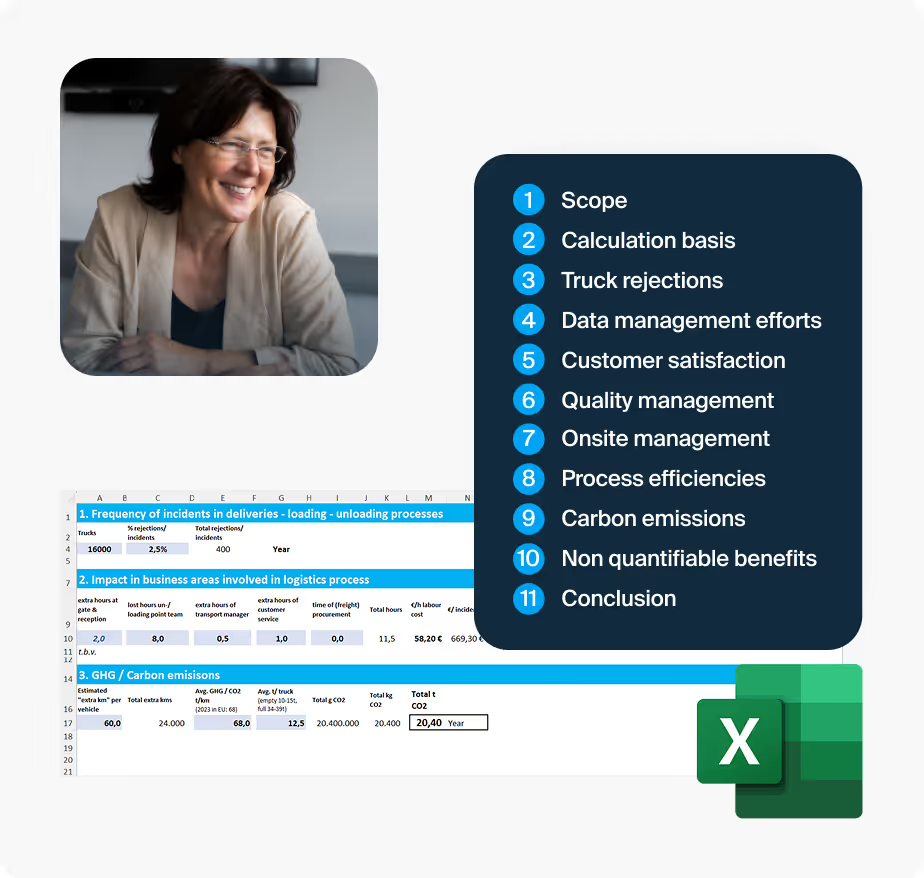
If necessary, we can help you calculate the benefit case, which shows the benefits and savings potential of Loady for your company — with a comprehensible method, real figures and a clear ROI assessment for a well-founded decision.


With a well-founded analysis, the benefit case shows what savings potential can be realized by Loady. Existing processes are examined closely in order to create a realistic basis for decision-making.
Outcome: A robust benefit case for decision-making
At Loady, digital enablement does not mean replacing existing processes or introducing new systems. It means creating digital working capacity and cross-system communication so that digitization, automation and AI can develop their potential. This is the basis for the benefits that companies are striving for: more efficient logistics processes, higher planning security, lower costs, more resilience and lower personnel costs.
If necessary, we can help you calculate the benefit case, which shows the benefits and savings potential of Loady for your company — with a comprehensible method, real figures and a clear ROI assessment for a well-founded decision.

Complex coordination between shippers, freight forwarders and drivers.
LKWs stehen an der Rampe, Slots gehen verloren.
Costs are increasing due to unnecessary waiting times and delays.
Aufwändige Abstimmungen zwischen Verlader, Speditionen und Fahrer.
LKWs stehen an der Rampe, Slots gehen verloren.
Kosten steigen durch unnötige Wartezeiten und Verzögerungen.

Klare, standardisierte Ladeanforderungen reduzieren manuelle Abstimmung, Wartezeiten und Fehlfahrten – das spart Standgeld, Personalkosten und vermeidet unnötige Zusatzkilometer.

Changes to opening hours or security requirements are synchronized in real time so that shipments run without delays.

Chemical parks with multiple service providers benefit from centrally managed charging requirements that are automatically synchronized and available to all parties involved.

No scattered data, no unclear free texts — with Loady, shippers, freight forwarders and goods recipients can access a centrally networked, up-to-date and standardized data source at any time. This ensures that every delivery remains smooth, without misunderstandings or manual queries.
Ask all questions and get an idea of the potential for logistics processes in your company.

Set up your site in just a few minutes and share your general site information directly with suppliers and logistics partners - it's free of charge.
Clear indications, fewer clarifying questions, greater efficiency!
In order to avoid media breaks and to automatically use correct data on loading requests in logistics processes, we offer various public APIs. We adapt these as required so that companies can seamlessly integrate data from Loady with existing ERP, TMS, yard management, procurement, eCommerce or telematics systems.


The majority of misunderstandings when picking up or delivering products are caused by missing information, unclear requirements or conflicting information. Loady ensures that relevant logistics data is passed on in a structured, up-to-date and understandable way along the process chain — across systems, locations and language borders.

Fewer operational queries
Loady creates a common, structured information base for all parties involved in a transport. Logistic-relevant requirements are maintained centrally and made available throughout the entire process — regardless of systems, roles or partners.
Not only is the implementation of the instruction relevant, but also its complete documentation and verifiability. This includes:
Digital driver instructions enable:
In this way, security and compliance requirements can be met — even with changing people and without additional effort in day-to-day business.